
Marine diesel hose clamps are small components that play a major role in preventing leaks, overheating, fuel-system failures, and offshore breakdowns.
At 805 Marine Diesel Mechanic, marine-grade hose clamp upgrades are commonly performed during cooling-system repairs, fuel-system service, exhaust maintenance, seawater plumbing repairs, and preventative diesel maintenance throughout Ventura Harbor, Oxnard, Channel Islands Harbor, and Santa Barbara Harbor.
Before assuming a leak is caused by a failed hose alone, start with the Marine Diesel Troubleshooting Guide. Hose failures, overheating, air intrusion, coolant leaks, and seawater leaks often involve clamp selection, corrosion, vibration, or improper installation.
Schedule Marine Hose Inspection
Why Marine Hose Clamps Matter
Marine diesel engines rely heavily on hoses throughout the cooling system, fuel system, exhaust system, crankcase ventilation system, and seawater plumbing. Every hose connection depends on the clamp maintaining consistent pressure while exposed to heat cycles, vibration, saltwater, engine movement, and corrosion.
When a hose clamp fails, the results can become severe very quickly:
- Cooling-system leaks
- Fuel leaks
- Seawater flooding
- Air intrusion into fuel systems
- Exhaust leakage
- Engine overheating
- Loss of coolant pressure
- Turbocharger overheating
Even a small leak around a hose barb or fitting can gradually worsen under vibration and thermal expansion.
For broader cooling-system support, visit the Cooling System Diagnosis Center.
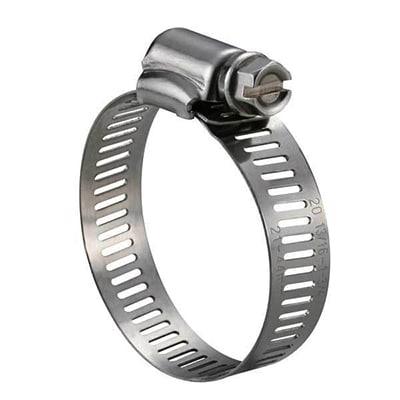
Perforated Stainless Steel Hose Clamps
The standard perforated worm-drive hose clamp is extremely common throughout marine applications. However, the perforations cut into the band reduce the clamp’s overall cross-sectional strength.
As the clamp is tightened:
- The perforations weaken the band
- The band can elongate under load
- Micro-cracking may begin
- Crevice corrosion can develop
- The threads may strip under overtightening
When perforated clamps fail, they often split directly along the perforation pattern due to corrosion, overstress, or fatigue.
Constant Torque Hose Clamps
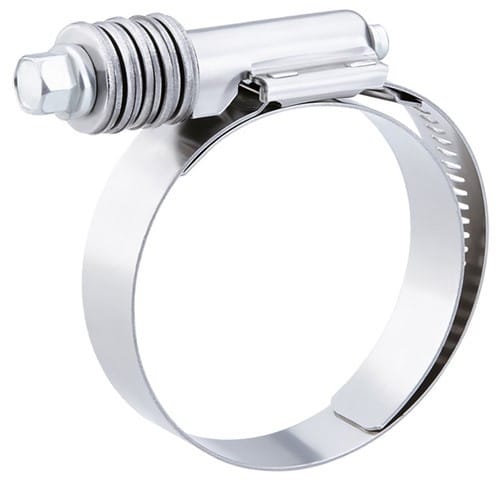
Constant torque hose clamps are often one of the best upgrades available for marine diesel cooling and seawater systems. Rubber hose material naturally compresses and “cold flows” after installation, especially after repeated heating and cooling cycles.
Traditional clamps lose tension as the hose relaxes over time. Constant torque clamps use a spring-loaded Belleville assembly that actively compensates for expansion and contraction by adjusting clamp tension automatically.
Advantages include:
- More consistent sealing pressure
- Reduced retightening requirements
- Improved performance during heat cycles
- Better long-term hose sealing
- Reduced leak risk
These clamps are especially useful on cooling systems, turbocharger plumbing, charge-air systems, and larger seawater hoses.
T-Bolt Stainless Steel Hose Clamps
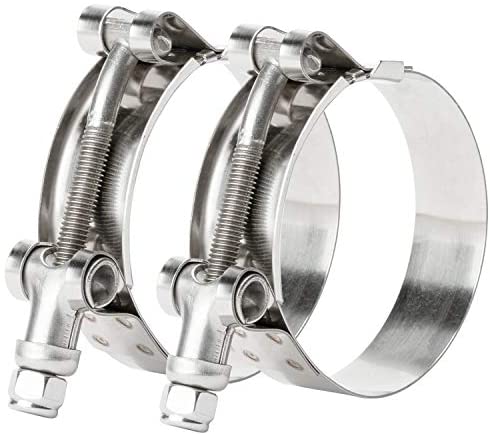
T-bolt hose clamps can apply substantial clamping force and are often used on larger marine hoses, charge-air systems, turbocharger plumbing, exhaust connections, and high-pressure applications.
However, some T-bolt designs concentrate clamping force more heavily near the bolt section rather than distributing it perfectly around the hose circumference.
When properly selected and installed, T-bolt clamps provide:
- Strong holding force
- Good vibration resistance
- Improved durability
- Better performance on larger-diameter hoses
For broader turbocharger and intake-system support, visit the Marine Diesel Engine Services page.
Double Bolt Marine Hose Clamps
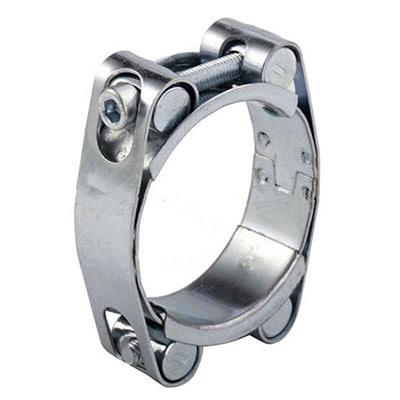
Double bolt stainless steel hose clamps are among the strongest marine hose clamps commonly used on heavy-duty marine diesel applications. These clamps use dual tightening points to apply more even pressure around larger hoses.
Benefits include:
- High clamping force
- Improved pressure distribution
- Heavy-duty construction
- Excellent durability
- Better sealing on larger hoses
These clamps are commonly used on:
- Exhaust hoses
- Large seawater hoses
- Wet exhaust systems
- Commercial diesel cooling systems
- High-vibration applications
For Cummins-specific marine diesel support, visit Cummins Marine Services.
Why Marine Clamps Fail
Marine hose clamps operate in an aggressive saltwater environment where corrosion, vibration, heat, moisture, and engine movement all accelerate wear.
Common causes of clamp failure include:
- Crevice corrosion
- Improper material selection
- Overtightening
- Undertightening
- Improper clamp sizing
- Saltwater exposure
- Vibration fatigue
- Poor hose condition
Even stainless steel can corrode in marine environments when oxygen becomes trapped inside tight crevices around the clamp band.
Cooling-System and Seawater Hose Applications
Cooling-system hoses experience continuous thermal cycling as engines heat and cool repeatedly during operation. Seawater hoses also experience internal salt exposure that can accelerate clamp corrosion externally and internally.
Marine diesel hose clamp inspections should include:
- Checking for rust staining
- Inspecting screw housings
- Checking for stripped threads
- Inspecting hose compression
- Checking clamp tension
- Inspecting for salt buildup
- Looking for coolant seepage
For related seawater-system reliability support, visit Marine Engine Fresh Water Flushing System.
Fuel-System Hose Clamp Considerations
Fuel-system hose clamps must maintain reliable sealing without damaging fuel hose construction. Air intrusion into diesel fuel systems can create hard-start conditions, rough operation, injector problems, and engine shutdowns.
For related fuel-system diagnostics, visit the Fuel System Diagnosis Center.
Fuel-system inspections should include:
- Checking for seepage around fittings
- Inspecting return-line clamps
- Checking fuel-filter hose connections
- Inspecting primer pump connections
- Looking for hose hardening or cracking
Marine Exhaust Hose Clamp Requirements
Exhaust systems place some of the harshest demands on marine hose clamps due to high heat, vibration, moisture, and constant engine movement. Exhaust hose failures can quickly become dangerous because leaking seawater and exhaust gases may enter the engine room.
Exhaust clamp systems should:
- Resist corrosion
- Maintain high clamping force
- Handle thermal expansion
- Prevent hose migration
- Tolerate vibration
Large wet-exhaust hoses commonly use heavy-duty double bolt or T-bolt clamp systems for additional security.
Preventive Hose and Clamp Maintenance
Marine hose clamps should be inspected routinely during preventive maintenance. A clamp may appear acceptable externally while internal corrosion weakens the band underneath.
Routine maintenance should include:
- Inspecting all hose clamps annually
- Replacing corroded clamps proactively
- Checking for coolant or fuel seepage
- Verifying proper clamp sizing
- Checking hose flexibility and condition
- Inspecting engine vibration levels
For recurring maintenance support, visit the Marine Diesel Engine Maintenance Schedule.
For marine-grade clamp reference information, visit West Marine Hose Clamps and PYI 316 Stainless Steel Hose Clamps.
Marine Hose Clamp Service in Ventura and Santa Barbara
805 Marine Diesel Mechanic provides marine hose inspections, cooling-system hose replacement, fuel-system hose service, seawater-system maintenance, exhaust-system hose upgrades, and marine-grade hose clamp replacement throughout Ventura Harbor, Oxnard, Channel Islands Harbor, and Santa Barbara Harbor.
For local mobile service support, visit Marine Mechanic Ventura CA and Mobile Marine Services Santa Barbara.
Small hose-clamp failures can quickly become large marine diesel repair problems if leaks develop offshore.
Contact 805 Marine Diesel Mechanic
Why are marine hose clamps important?
Marine hose clamps secure cooling, fuel, seawater, and exhaust hoses while preventing leaks, vibration damage, and system failure.
What causes marine hose clamps to fail?
Common causes include corrosion, overtightening, vibration fatigue, improper sizing, and saltwater exposure.
What is a constant torque hose clamp?
A constant torque clamp uses a spring-loaded mechanism to maintain sealing pressure as hoses expand and contract during heat cycles.
Why are constant torque clamps useful on marine engines?
They compensate for hose compression and thermal expansion, helping reduce coolant and seawater leaks over time.
What are perforated hose clamps?
Perforated clamps use slots cut into the band to form threads, but the perforations can weaken the clamp structure.
Can stainless steel hose clamps still corrode?
Yes. Stainless steel can experience crevice corrosion in saltwater environments, especially around trapped moisture.
What are T-bolt hose clamps used for?
T-bolt clamps are commonly used on larger-diameter hoses, turbo plumbing, cooling systems, and high-pressure applications.
What are double bolt marine hose clamps?
Double bolt clamps use dual tightening points to provide stronger and more even pressure around larger marine hoses.
Can a bad hose clamp cause overheating?
Yes. Cooling-system leaks or seawater leaks caused by failed clamps can contribute to overheating.
How often should marine hose clamps be inspected?
Marine hose clamps should be inspected during annual maintenance and anytime leaks or vibration appear.
Can hose clamps affect fuel-system reliability?
Yes. Loose or leaking clamps can allow air intrusion or fuel seepage in diesel fuel systems.
Why are exhaust hose clamps important?
Exhaust hose clamps secure wet exhaust systems exposed to heat, vibration, seawater, and engine movement.
Can overtightening damage a hose clamp?
Yes. Overtightening can strip threads, weaken clamp bands, or damage the hose itself.
Do marine hose clamps need to be marine grade?
Yes. Marine-grade stainless steel clamps are designed to better resist corrosion and harsh marine environments.
Can vibration loosen hose clamps?
Yes. Constant vibration and thermal cycling can gradually reduce clamp tension over time.
Should hose clamps be replaced proactively?
Yes. Corroded or weakened clamps should often be replaced before they fail offshore.
Can cooling-system hoses shrink after installation?
Yes. Rubber hoses naturally compress and relax after installation, which can reduce clamp tension.
What systems use marine hose clamps?
Cooling systems, fuel systems, exhaust systems, seawater plumbing, turbo plumbing, and ventilation systems all use hose clamps.
Can a hose clamp leak slowly before failing?
Yes. Small coolant or fuel seepage often appears before major clamp failure develops.
Where does 805 Marine Diesel Mechanic provide hose clamp service?
805 Marine Diesel Mechanic provides marine hose and clamp service throughout Ventura Harbor, Oxnard, Channel Islands Harbor, and Santa Barbara Harbor.