
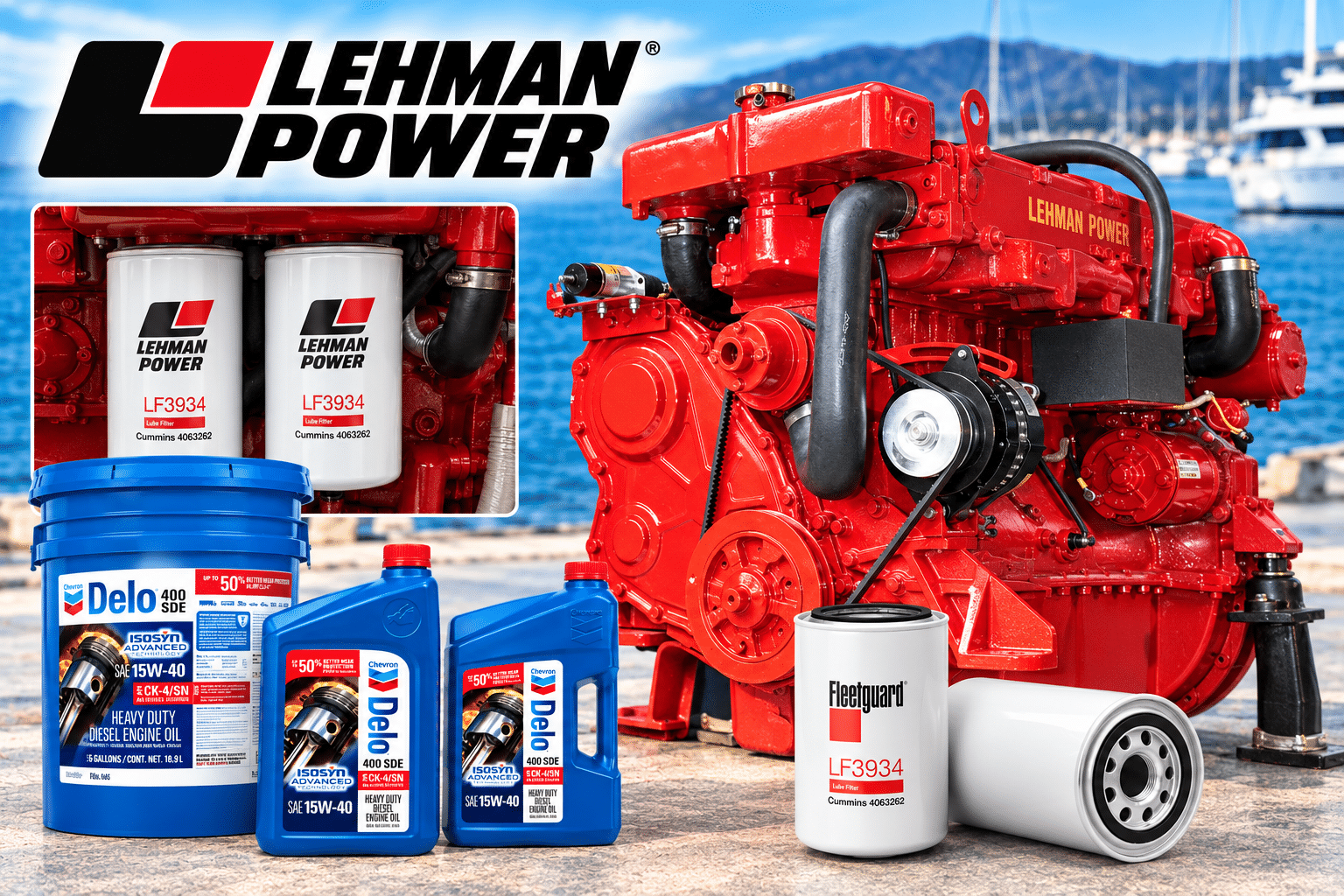
This Ford Lehman marine engine oil type and capacity chart covers popular Lehman 80, 90, 120, 135 and Super-series marine diesel engines. It provides practical oil quantities, filter part numbers and lubricant guidance for owners preparing an oil service. For help diagnosing low oil pressure, excessive smoke, overheating or engine performance problems, visit our Marine Diesel Troubleshooting Guide.
Ford Lehman Marine Engine Oil Type & Capacity Chart
Common marine diesel oil quantities, original Lehman filter numbers and oil recommendations for the engines that powered generations of trawlers, sailboats and cruising motor yachts.
Ford Lehman Oil Type, Capacity & Filter Chart
| Ford Lehman Engine | Oil Capacity | Common Oil Filter | Common Oil Type |
|---|---|---|---|
| Lehman 80 HP / 4D242 | 8 US qt / 7.6 L | Lehman 2N50 | SAE 15W-40 heavy-duty diesel oil, where approved |
| Lehman 120 HP / 6D380 / 2715E | 12 US qt / 11.4 L | Lehman 2N50 | SAE 15W-40 heavy-duty diesel oil, where approved |
| Lehman Super 90 / SP90 | 11.2 US qt / 10.6 L initial fill | 2N50 early; 2N53 later | SAE 15W-40 heavy-duty diesel oil, where approved |
| Lehman Super 135 / SP135 | 19.8 US qt / 18.7 L initial fill | 2N50 early; 2N53 later | SAE 15W-40 heavy-duty diesel oil, where approved |
| Lehman SP185 | 23.5 US qt / 22.0 L initial fill | Ford 1612468 manual reference* | SAE 15W-40 heavy-duty diesel oil, where approved |
| Lehman SP225 | 23.5 US qt / 22.0 L initial fill | Ford 1612468 manual reference* | SAE 15W-40 heavy-duty diesel oil, where approved |
| Lehman SP275 | 24 US qt / 22.5 L initial fill | Ford 1612468 manual reference* | SAE 15W-40 heavy-duty diesel oil, where approved |
The chart gives the documented standard configuration rather than leaving the oil-capacity column blank. For an ordinary service, add slightly less than the expected quantity and use the engine’s calibrated dipstick to establish the final level.
What Oil Should You Use in a Ford Lehman Marine Diesel?
Ford Lehman engines were built during an era when engine oil specifications were considerably different from those used for modern electronically controlled marine diesels. Many original manuals identify single-grade and multigrade oils according to ambient temperature.
Today, a quality SAE 15W-40 heavy-duty diesel engine oil is commonly used in older Ford Lehman marine engines, provided it is compatible with the engine’s required lubricant classification and operating conditions.
Chevron Delo and Shell Rotella are common options, but the particular formulation must be suitable for the engine. The brand alone does not establish compatibility, especially when an older manual lists a now-obsolete API specification.
Ford Lehman 80 vs. 120 — The Two Classic Cruising Engines
Among older trawlers and cruising sailboats, the naturally aspirated Lehman 80 and Lehman 120 remain two of the most recognizable marine diesel engines.
Lehman 80 HP
The four-cylinder 4D242 engine uses a commonly documented 8 US quarts of oil with the filter. Its mechanically governed fuel system and straightforward construction made it popular in displacement vessels.
Lehman 120 HP
The six-cylinder 6D380/2715E engine uses a commonly documented 12 US quarts of oil with the filter. The engine became especially popular in long-range trawlers, where moderate engine speed and regular preventive maintenance are important.
Both engines require attention to oil pressure, cooling-system condition, raw-water pump service, fuel filtration and exhaust-system integrity.
Ford Lehman 80 HP
The naturally aspirated Lehman 80 is a familiar engine in older cruising sailboats and smaller displacement trawlers.
Oil capacity: 8 US qt / 7.6 L
Common filter: 2N50
Oil: SAE 15W-40 where approved
Ford Lehman 120 HP
The Lehman 120 is one of the best-known engines in traditional trawlers and long-distance cruising vessels.
Oil capacity: 12 US qt / 11.4 L
Common filter: 2N50
Oil: SAE 15W-40 where approved
Lehman SP90
The SP90 is a later four-cylinder marine diesel with a documented initial-fill oil capacity of approximately 10.6 liters.
Initial fill: 11.2 US qt / 10.6 L
Filter: 2N50 early; 2N53 later
Lehman SP135
The SP135 provides more rated horsepower than the classic Lehman 120 and uses a larger lubrication system.
Initial fill: 19.8 US qt / 18.7 L
Filter: 2N50 early; 2N53 later
Lehman SP185
The SP185 adds turbocharging and increased output. Clean oil and correct filtration are especially important for turbocharger-bearing protection.
Initial fill: 23.5 US qt / 22.0 L
Filter reference: Ford 1612468*
Lehman SP225
The SP225 is a higher-output six-cylinder marine diesel with additional demands on its cooling, intake and lubrication systems.
Initial fill: 23.5 US qt / 22.0 L
Filter reference: Ford 1612468*
Lehman SP275
The SP275 is one of the higher-output models in the classic Lehman Super-series range.
Initial fill: 24 US qt / 22.5 L
Filter reference: Ford 1612468*
Ford Base Engine vs. Lehman Model
A Ford base-engine designation and a Lehman marine marketing designation can describe the same engine. Recording both numbers helps identify the correct service manual and replacement parts.
Example: Ford 2715E / Lehman 120 HP.
Ford Lehman Oil Filters — 2N50 vs. 2N53
The original Lehman filter references are particularly useful because the same engine family can have more than one filter arrangement.
| Filter Number | Common Application | Service Note |
|---|---|---|
| 2N50 | Classic Lehman 80 and 120; earlier SP90/SP135 | Original Lehman spin-on filter reference |
| 2N53 | Later SP90/SP135 with revised filter fitting | Introduced with revised mounting arrangement |
| Ford 1612468 | Original manual reference for larger SP-series engine group | Confirm present replacement by engine and filter housing |
Ford Lehman Marine Diesel Service
Oil & Filter Service • Diagnostics • Fuel Systems • Cooling Systems • Heat Exchangers • Marine Engine Surveys
Ventura • Oxnard • Channel Islands Harbor • Santa Barbara
Ford Lehman Oil Change — Proper Service Procedure
1. Warm the Engine
Warm the engine sufficiently for the oil to flow freely, while avoiding burns from hot engine surfaces and oil.
2. Extract the Old Oil
Use the installed oil-change pump or an appropriate marine extraction system. Record the approximate amount removed and inspect for abnormal contamination.
3. Replace the Correct Oil Filter
Check whether the engine uses 2N50, 2N53 or another installed filter arrangement. Inspect the sealing surface and ensure the old gasket has been removed.
4. Add the Recommended Engine Oil
Begin below the expected service quantity. The listed capacity is a planning reference, not an instruction to add every quart immediately.
5. Verify Oil Pressure and Leaks
After starting the engine, confirm that normal oil pressure develops promptly. Inspect the filter, drain system and oil lines.
6. Recheck the Dipstick
Shut down, allow appropriate drain-back time and adjust to the correct dipstick mark.
Oil Analysis on Older Ford Lehman Engines
Many Lehman marine engines have accumulated thousands of operating hours over several decades. Oil analysis can help identify abnormal wear metals, fuel dilution, coolant contamination and changes in lubricant viscosity.
For pre-purchase evaluations, oil analysis should be considered alongside cold-start behavior, oil-pressure readings, cooling-system condition, blow-by observations and sea-trial performance.
Our Marine Engine Survey Services provide a broader evaluation of engine condition than oil analysis alone.
Ford Lehman Preventive Maintenance
These engines are valued for their mechanical simplicity, but age-related maintenance is especially important. Raw-water pump impellers, heat exchangers, coolant hoses, belts, fuel lines, exhaust elbows and oil-cooler connections should be inspected according to their condition and service history.
Oil leaks around older gaskets and filter housings should not be ignored. A relatively small leak can become significant during an extended passage, particularly when an engine operates for many continuous hours.
Maintain a service log recording oil type, quantity added, filter number, engine hours, oil-pressure readings and any unusual findings. This makes future servicing more consistent and helps identify changes before they become major failures.
Ford Lehman Technical References
For additional engine identification and service information, consult the American Diesel Corporation Lehman owners guides and the original Lehman Super-series owners manual.
These references are especially helpful for distinguishing older 80/120 HP engines from later SP90/SP135 engines and identifying the correct original filtration system.
Need Help With a Ford Lehman Marine Diesel?
805 Marine Diesel Mechanic provides mobile diesel diagnostics, maintenance, oil and filter service, cooling-system repair and marine engine surveys.
Ventura • Oxnard • Channel Islands Harbor • Santa Barbara
Ford Lehman Marine Engine Oil & Filter FAQ
20 frequently asked questions covering Lehman 80, 90, 120, 135, SP185, SP225 and SP275 marine diesel engines.
1. What oil should I use in a Ford Lehman marine diesel?
SAE 15W-40 heavy-duty diesel engine oil is a common modern service choice for many classic Ford Lehman marine diesels operating in moderate or warm conditions. However, the oil must be compatible with the engine’s original lubricant requirements and operating temperature range.
For additional engine-maintenance information, see our Marine Diesel Troubleshooting Guide.
2. Can I use Chevron Delo or Shell Rotella in a Ford Lehman?
Yes, suitable Chevron Delo or Shell Rotella heavy-duty diesel oils are commonly used in older Ford Lehman engines. Choose the correct viscosity and a formulation compatible with the engine’s lubricant specifications rather than selecting oil by brand name alone.
3. How much oil does a Ford Lehman 80 HP engine hold?
The classic four-cylinder Ford Lehman 80 HP engine commonly uses approximately 8 US quarts (7.6 liters) of engine oil. This is a practical standard-configuration service reference; establish the final operating level using the engine’s calibrated dipstick.
4. How much oil does a Ford Lehman 120 HP engine hold?
The classic six-cylinder Ford Lehman 120 HP, commonly associated with the Ford 2715E/6D380 engine, uses approximately 12 US quarts (11.4 liters) in the standard configuration. Do not add the entire amount without checking the dipstick during the refill process.
5. What oil filter does a Ford Lehman 120 use?
The original Lehman 2N50 is a common oil-filter reference for the classic 120 HP engine. Check the installed filter and mounting arrangement because some older engines have been fitted with replacement or modified filter housings.
6. What oil filter does a Ford Lehman 80 use?
The original Lehman 2N50 is a common filter reference for the classic 80 HP four-cylinder engine. Compare the existing filter with the replacement and verify the sealing arrangement before installation.
7. How much oil does a Lehman SP90 hold?
The Lehman SP90 has a documented standard initial-fill capacity of approximately 10.6 liters (11.2 US quarts). A normal oil change may require less because some oil remains in the lubrication system.
8. How much oil does a Lehman SP135 hold?
The Lehman SP135 has a documented initial-fill capacity of approximately 18.7 liters (19.8 US quarts). The amount added during a routine oil change may be lower than the initial-fill figure.
9. What is the difference between Lehman 2N50 and 2N53 oil filters?
The 2N50 is associated with earlier Lehman oil-filter installations, while the 2N53 is used on certain later SP90 and SP135 engines with a revised filter fitting. The original Lehman documentation warns that these filters are not directly interchangeable on every installation.
Always identify the installed filter head before selecting a replacement.
10. How much oil does a Lehman SP185 hold?
The Lehman SP185 has a documented initial-fill capacity of approximately 22.0 liters (23.5 US quarts). For a routine service, add oil gradually and establish the correct operating level with the dipstick.
11. How much oil does a Lehman SP225 hold?
The Lehman SP225 has a documented initial-fill capacity of approximately 22.0 liters (23.5 US quarts). The exact routine refill quantity depends on how completely the oil drains from the engine and its installed components.
12. How much oil does a Lehman SP275 hold?
The Lehman SP275 has a documented initial-fill capacity of approximately 22.5 liters (24 US quarts). A routine oil change can require less than this amount because the system does not drain completely.
13. What oil filter is used on Lehman SP185, SP225 and SP275 engines?
Ford 1612468 is an original manual filter reference associated with the larger Lehman Super-series engine group. The current replacement should be confirmed using the exact engine designation and installed filter arrangement before ordering.
14. Why do Ford Lehman oil-capacity references sometimes disagree?
One reference may list a complete initial fill, while another lists the amount normally replaced during an oil change. Differences in sump design, marine conversion equipment, dipsticks and installation configuration can also affect the quantity required.
15. Should I pour the entire published oil capacity into a Lehman engine?
No. Add somewhat less than the expected capacity, check the dipstick, then start the engine and verify oil pressure and filter sealing. After shutting down and allowing the oil to drain back, adjust the level to the appropriate dipstick mark.
16. Can overfilling damage a Ford Lehman marine diesel?
Yes. Excessive oil can contribute to crankshaft windage, oil aeration, increased crankcase pressure and abnormal oil consumption. Maintaining the correct oil level is particularly important on older marine engines with uncertain service histories.
17. How often should I change oil in a Ford Lehman marine engine?
Follow the maintenance interval specified for the exact Lehman model and its operating conditions. On older cruising engines with limited annual use, changing the oil and filter at least annually is a common preventive-maintenance practice, even when engine hours remain relatively low.
18. What causes low oil pressure in a Ford Lehman engine?
Possible causes include insufficient oil, incorrect viscosity, excessive oil temperature, a faulty pressure sender or gauge, a restricted pickup, or internal bearing wear. Confirm the reading with an accurate mechanical gauge before drawing conclusions about internal engine condition.
See our Marine Diesel Troubleshooting Guide for additional diagnostic guidance.
19. Is oil analysis worthwhile on an older Ford Lehman?
Yes. Oil analysis can reveal abnormal wear metals, fuel dilution, coolant contamination and lubricant degradation. It is especially valuable when evaluating a used vessel, although it should be combined with cold-start observations, oil-pressure checks and other mechanical inspections.
Learn more about our Marine Engine Survey Services.
20. What should be inspected during a Ford Lehman oil service?
In addition to changing the oil and correct filter, inspect the filter housing, oil cooler, oil hoses, drain fittings and engine for leaks. Check oil pressure after restarting, and include fuel filtration, belts, raw-water pump, cooling hoses, heat exchanger and exhaust components in the engine’s preventive-maintenance schedule.
Ford Lehman Marine Diesel Service
Family-owned and operated with over 30 years of marine engine experience.
Oil & Filter Service • Engine Diagnostics • Fuel Systems • Cooling Systems • Heat Exchangers • Marine Engine Surveys
Ventura • Oxnard • Channel Islands Harbor • Santa Barbara
One Response