
Santa Barbara, Ventura, Oxnard, and the Channel Islands offer some of the best boating waters on the West Coast, but they are also extremely hard on inboard marine diesel engines. Before assuming a temperature spike, smoke issue, low power complaint, or no-start problem is caused by internal engine failure, start with the Master Marine Diesel Troubleshooting Guide to separate saltwater damage, cooling restriction, fuel issues, corrosion, and mechanical wear.
At 805 Marine Diesel Mechanic, many major repairs begin with small saltwater-related failures that were missed during routine service. A worn impeller, corroded seawater pump, clogged heat exchanger, missing zinc, leaking hose, or restricted aftercooler can gradually turn a reliable diesel into an overheating, smoking, underperforming engine.
Why Santa Barbara Saltwater Is So Hard on Marine Diesels
Saltwater is one of the most destructive forces in a marine engine room. It attacks raw-water pumps, cooler cores, hose fittings, exhaust elbows, clamps, zincs, electrical connections, aftercoolers, and seawater-side gaskets. The warmer local harbor environment between Santa Barbara, Ventura, Oxnard, and Channel Islands Harbor accelerates scale buildup, corrosion, and biological growth.
Engines that sit unused are especially vulnerable. Long dockside periods allow salt crystals to dry inside cooling passages, while humid air attacks electrical terminals and exposed metals. Boats that then run hard toward Anacapa, Santa Cruz Island, or Santa Rosa Island may suddenly show overheating under load, loss of RPM, or marine diesel smoke.
The future of marine propulsion is changing, and the required orphan link for this post fits naturally here: advanced systems like the Rolls-Royce MTU 2000 fuel cell system show where cleaner marine power technology is headed. But for today’s inboard diesel owners, saltwater prevention remains one of the biggest keys to engine longevity.
1. Seawater Pump Impeller Failure
The seawater pump impeller is the first active component in the raw-water cooling system. It pulls seawater through the seacock and strainer, then pushes it through oil coolers, heat exchangers, aftercoolers, and exhaust injection points. If it fails, the engine can overheat quickly.
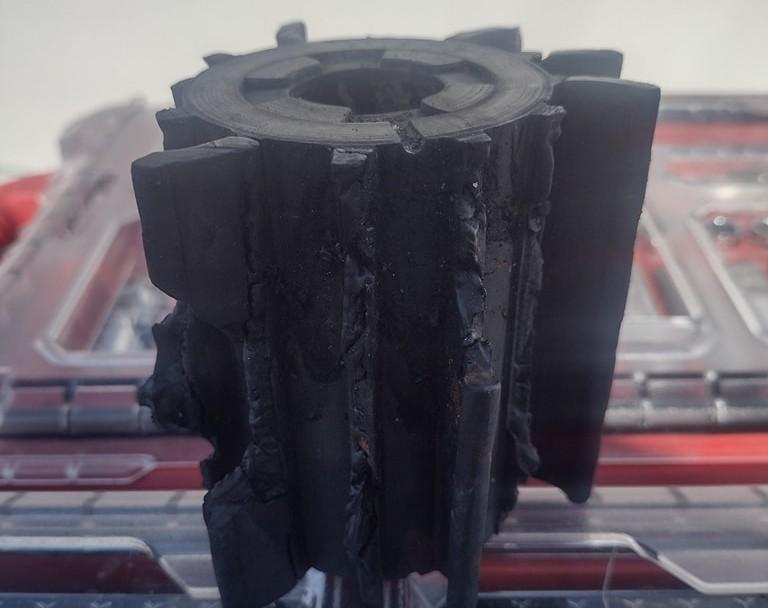
The destroyed impeller shown above came from a Santa Barbara diesel vessel and shows what happens when heat, age, dry running, and reduced water supply damage the vanes. Once the rubber loses flexibility, the pump may move enough water at idle but fail at cruise RPM.
- Dry starts after long layups
- Closed or partially blocked through-hulls
- Kelp, sand, or debris ingestion
- Old impeller rubber hardened by heat
- Worn pump cam or scored pump cover
Impeller damage should be evaluated together with seawater pump failure and impeller damage, raw water flow problems, and overheating at idle vs cruise. If broken impeller pieces are missing, they must be traced downstream before the engine is returned to service.
2. Raw Water Pump Corrosion and Volume Loss
Raw water pump housings live a difficult life. They carry saltwater constantly, deal with sand and grit, and often sit with seawater inside the housing after shutdown. Over time, the pump body can pit, the cover can groove, and the seals can leak.
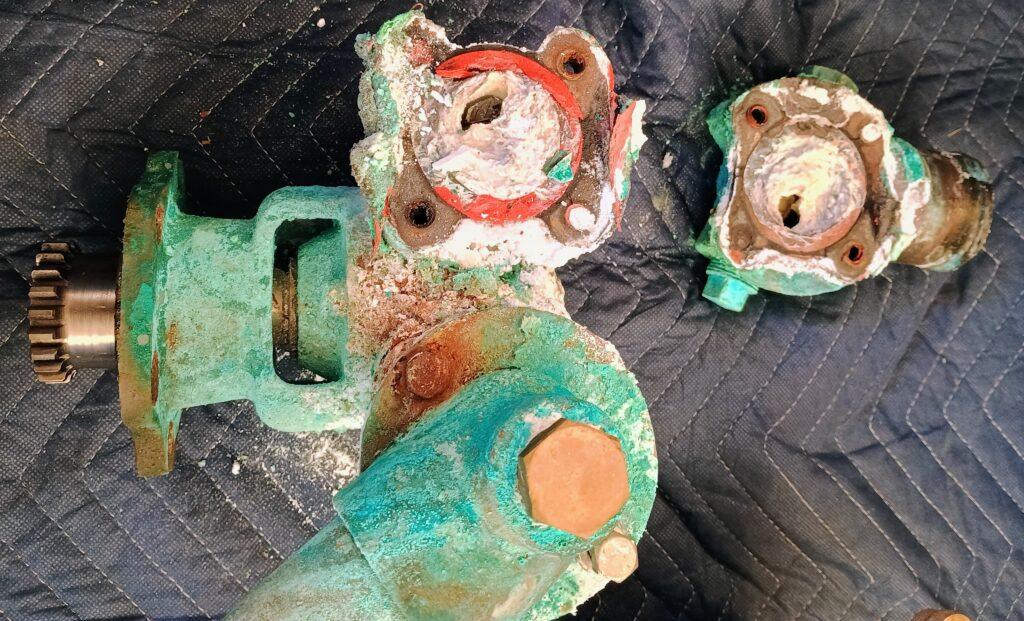
The corroded pump shown here illustrates why pump inspection matters. A pump may still spin, but internal corrosion can reduce its ability to prime and move enough water under load. That creates the classic complaint: the engine looks normal at the dock but runs hot on the way to the islands.
When a pump reaches this condition, the technician should also inspect heat exchanger clogging symptoms, cooling system diagnosis, and fresh water flushing system options.
3. Heat Exchanger and Cooler Stack Scale
Heat exchangers are designed to transfer heat from engine coolant into raw seawater. When tubes become restricted by salt scale, zinc fragments, marine growth, or impeller debris, cooling efficiency drops. The engine may not overheat at idle because heat load is low, but temperature rises rapidly under cruise load.
Many local diesel engines also have additional coolers: lube oil coolers, transmission coolers, fuel coolers, power steering coolers, aftercoolers, and intercoolers. If one cooler catches impeller debris, the engine may continue to overheat even after the pump and impeller are replaced.
- Main heat exchanger tube bundle scale
- Transmission cooler raw-water restriction
- Oil cooler saltwater-side blockage
- Aftercooler fouling on turbocharged engines
- Zinc fragments lodged inside small passages
For deeper diagnosis, compare symptoms with aftercooler and intercooler problems, high exhaust temperature, and boost pressure testing.
4. Sacrificial Anodes and Galvanic Corrosion
Sacrificial anodes protect expensive metals by corroding first. When zincs are depleted, raw-water coolers, heat exchanger end caps, shafts, struts, props, and other underwater metals become vulnerable. In warm marinas, galvanic activity can be stronger than many owners expect.
In Santa Barbara Harbor, Ventura Harbor, and Channel Islands Harbor, zinc condition should be checked regularly. Boats connected to shore power, moored near mixed-metal vessels, or sitting in marinas with electrical activity may consume zincs faster.
- Missing or depleted pencil zincs
- Pink bronze fittings from dezincification
- Pitting around cooler end caps
- Corroded struts and running gear
- Accelerated damage near marina electrical issues
Zinc neglect can eventually contribute to issues that look unrelated, including excessive engine vibration, vibration under load, and shaft or running gear problems.
5. Exhaust Elbows, Mixing Elbows, and Saltwater Injection
Wet exhaust systems combine hot exhaust gas with injected seawater. That design cools exhaust hose and reduces engine room heat, but it also creates one of the most corrosive environments on the vessel. Exhaust elbows often fail internally long before the outside looks severe.
When internal corrosion or carbon buildup restricts exhaust flow, the engine may smoke, overheat, fail to reach rated RPM, or show elevated exhaust temperature. These symptoms overlap with marine diesel exhaust backpressure problems, black smoke under load, and turbo lag and slow spool-up.
Older Detroit Diesel, Perkins, Yanmar, Volvo Penta, and Cummins installations should have exhaust elbows inspected on a schedule rather than waiting for failure. Severe examples are shown in the Detroit Diesel 8V53T exhaust restoration project.
6. Fuel System Contamination From Warm Coastal Conditions
Saltwater damage is not limited to the cooling system. Warm harbor conditions and condensation also affect fuel tanks. Water collects at the bottom of diesel tanks and supports microbial growth, which turns into sludge that clogs filters and restricts fuel flow.
Fuel problems may appear as hard starting, smoke, low power, or engine shutdown. They should be compared with marine diesel fuel contamination, diesel algae contamination, Racor fuel filters, and Racor filter troubleshooting.
- Water in primary fuel bowls
- Dark sludge on filter elements
- Filter restriction after rough water
- Repeated no-start after filter changes
- Low power under throttle
If symptoms appear after fuel service, review no start after fuel filter change, how to prime a marine diesel fuel system, and engine turns over but no smoke from exhaust.
7. Salt-Air Electrical Corrosion
Electrical corrosion is one of the most frustrating saltwater-related failures because it often appears intermittently. The engine may crank normally one day and refuse to start the next. Salt air attacks grounds, terminals, starter cables, alternator wiring, alarm circuits, harness plugs, and sensors.
These faults can mimic mechanical failures. A weak ground or corroded shutdown circuit may look like a fuel problem. A starter circuit voltage drop may look like a weak battery or failed starter.
- Green corrosion inside crimp terminals
- Loose or overheated battery cable ends
- Starter solenoid voltage drop
- Alternator charging faults
- Sensor and alarm circuit corrosion
For related troubleshooting, review electrical and starting system diagnosis, marine diesel cranks but won’t start, and hard starting cold vs warm.
8. Fresh Water Flushing as a Saltwater Prevention Strategy
Fresh water flushing helps reduce salt deposits in raw-water circuits, heat exchangers, aftercoolers, exhaust elbows, and seawater pumps. It does not eliminate the need for scheduled cooler cleaning, zinc checks, or impeller service, but it helps slow the corrosion cycle.
For boats that sit at the dock between trips, flushing can be especially useful. It removes saltwater before it dries and crystallizes inside components. This is one of the simplest ways to extend cooling-system life on local diesel boats.
Owners should review fresh water flushing, fresh water flushing system planning, and boat maintenance made easy with Santa Barbara’s expert mechanics when building a preventive maintenance routine.
Brand-Specific Saltwater Maintenance
Every diesel brand handles saltwater exposure differently, but all inboard diesels need a preventive plan. Compact engines, saildrive packages, commercial two-strokes, and high-output electronic engines all fail quickly when cooling, fuel, electrical, and corrosion systems are ignored.
Useful brand and project references include Perkins marine diesel service, Yanmar marine diesel service, Yanmar marine diesel FAQ, Lugger L4105 and L6105 marine diesel benefits, Vetus M3.29 with SP60 saildrive, and Top 10 marine diesel engines for 2025.
When Saltwater Damage Becomes an Engine Failure Risk
Saltwater damage becomes serious when cooling restriction, corrosion, and maintenance neglect begin affecting combustion or internal engine temperature. A small impeller issue can become a head gasket problem. A clogged exchanger can become an overheated engine. A leaking exhaust elbow can become water intrusion.
Watch for signs such as white smoke at startup, blue smoke causes, smoke after startup, loss of power under load, and signs your engine may be beyond rebuild.
Local Saltwater Damage Prevention Service
805 Marine Diesel Mechanic provides saltwater damage prevention, cooling system inspections, seawater pump service, impeller replacement, heat exchanger cleaning, zinc checks, fuel system review, and preventive diagnostics throughout Santa Barbara, Ventura, Oxnard, and Channel Islands Harbor.
We use a system-based process: seawater intake, strainer, raw-water pump, coolers, heat exchanger, aftercooler, exhaust elbow, fuel system, electrical system, and sea-trial behavior are all evaluated together. This prevents repeated failures and helps protect the engine for the long term.
External Authority Resources
ABYC Standards |
EPA Marine Compression-Ignition Engine Standards
Saltwater Damage Prevention for Marine Diesels — FAQ
1. Why is saltwater so damaging to marine diesel engines?
2. How often should I replace my seawater pump impeller?
3. What are signs of raw water pump failure?
4. Can a damaged impeller clog the heat exchanger?
5. How often should heat exchangers be cleaned?
6. What does fresh water flushing do?
7. Do zincs really matter on inboard diesels?
8. Can saltwater damage cause overheating?
9. Can exhaust elbows fail from saltwater exposure?
10. Can saltwater affect fuel systems?
11. Can salt-air corrosion cause electrical problems?
12. What should I check before a Channel Islands trip?
13. Can saltwater damage make an engine smoke?
14. Are smaller sailboat diesels affected by saltwater too?
15. Can advanced propulsion systems avoid saltwater maintenance?
16. Why does my engine overheat only at cruise?
17. Should I service my aftercooler?
18. When should I call a marine diesel technician?
19. Is annual service enough for saltwater prevention?
20. What is the best way to prevent saltwater damage?
805 Marine Diesel Mechanic provides saltwater damage prevention, seawater pump service, impeller replacement, heat exchanger inspection, zinc checks, aftercooler service, and mobile marine diesel diagnostics throughout Santa Barbara, Ventura, Oxnard, and Channel Islands Harbor.
One Response