
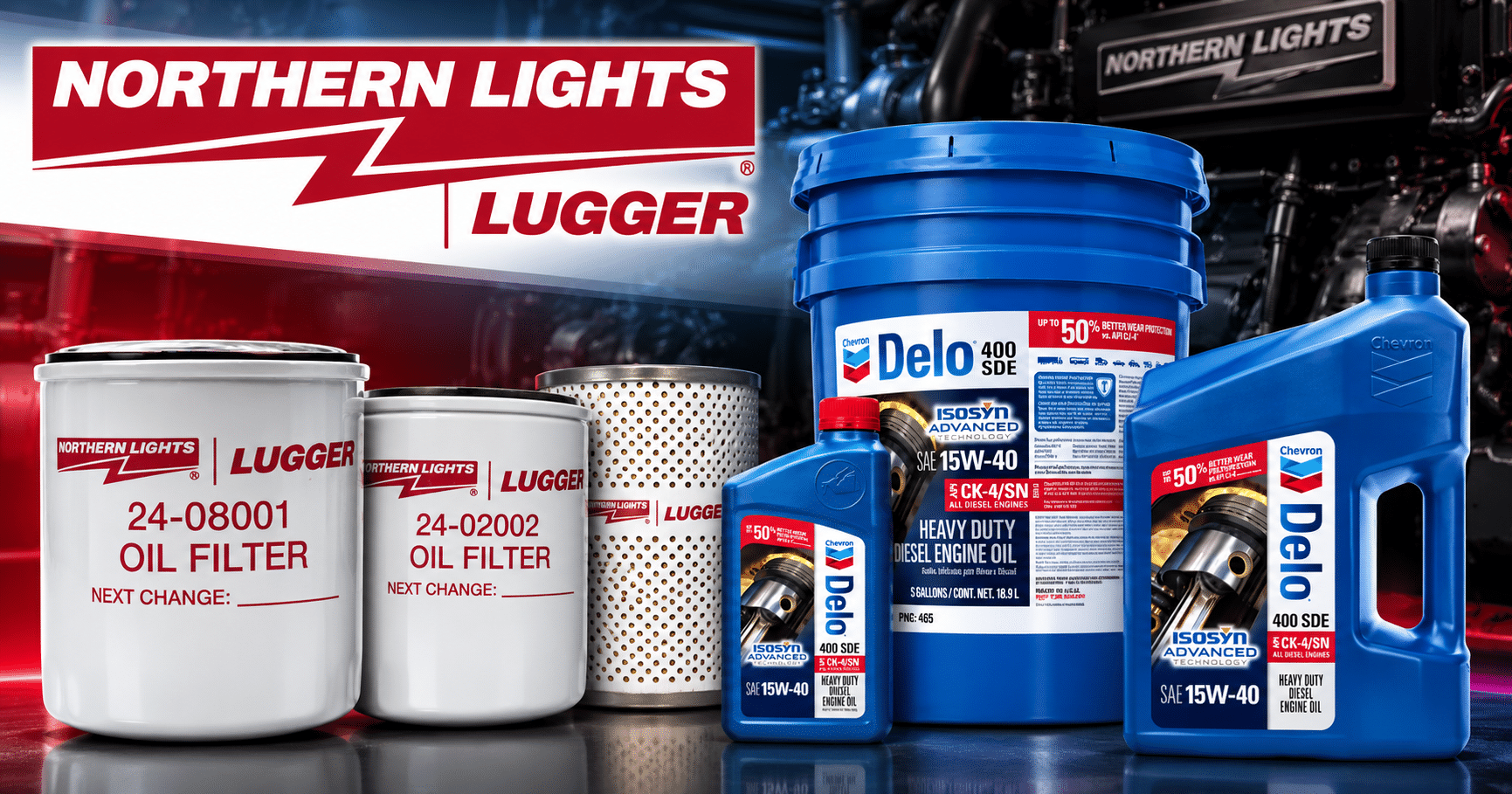
Knowing the correct oil type, engine-oil capacity and filter number is essential when servicing a Lugger marine diesel. This Lugger marine engine oil type and capacity chart covers popular Lugger propulsion engines ranging from classic 439 and 668 Series engines through the larger L6125, L6140 and L1276 families, while our Marine Diesel Troubleshooting Guide can help diagnose low oil pressure, excessive oil consumption, blue smoke, overheating and other diesel-engine problems.
Lugger Marine Engine Oil Type & Capacity Chart
Quick-reference engine-oil capacities, oil-filter information and lubricant recommendations for popular Lugger marine propulsion engines.
Lugger Marine Oil Capacity & Filter Chart
| Lugger Marine Engine | Standard Oil Capacity | Standard Oil Filter / Reference | Recommended Oil |
|---|---|---|---|
| L439D | 9 qt / 8.5 L | Full-flow spin-on — verify current replacement by serial number | SAE 30 or suitable 15W-40 heavy-duty diesel oil for temperatures above 32°F, according to manual specification |
| L439T | 14 qt / 13.2 L | Full-flow spin-on — verify current replacement by serial number | SAE 30 or suitable 15W-40 heavy-duty diesel oil according to operating temperature |
| L668 Series | 18 qt / 17 L | Full-flow spin-on — verify exact application | SAE 30 or suitable 15W-40 heavy-duty diesel oil according to manual and temperature |
| L1064 Series | 14–21.7 qt / 13.2–20.5 L depending on version* | Verify exact engine model and serial number | Heavy-duty diesel engine oil meeting the engine-generation specification |
| L1066T | 19 qt / 18 L | Verify current filter by serial number | Suitable heavy-duty diesel oil; 15W-40 commonly applicable above 32°F where specified |
| L1066A / L1066H | Approx. 32.5 qt / 34.3 L* | Verify current filter by engine model and serial number | Suitable heavy-duty diesel oil meeting Lugger specification |
| L6108 / L6108A | Verify exact engine and sump* | Lugger 2405701 / Fleetguard LF3664 reference* | Suitable heavy-duty diesel engine oil according to Lugger manual and operating temperature |
| L6105A / L6105H | Verify exact model, serial number & sump* | Verify by complete engine serial number | Heavy-duty diesel engine oil meeting Lugger specification |
| L6125A / L6125H | 34 qt / 32 L | Lugger 2404801 / Fleetguard LF747 reference* | SAE 30 or suitable SAE 15W-40 above 32°F according to applicable Lugger manual |
| L6140 Series | 40 qt / 38 L with new filter | Lugger 2404801 / Fleetguard LF747 reference* | SAE 30 or suitable SAE 15W-40 above 32°F according to applicable manual |
| L6170 Series | Verify exact model and sump* | Lugger 2404801 / Fleetguard LF747 reference* | Heavy-duty diesel engine oil meeting the applicable Lugger specification |
| L1276A / L1276A2 | 44–44.4 qt / 42 L | Verify current filter by engine serial number | API CH-4 / CJ-4 or other manual-approved heavy-duty multigrade oil; SAE 15W-40 above 32°F where specified |
IMPORTANT — VERIFY THE ENGINE MODEL, SERIAL NUMBER AND INSTALLATION:
Lugger marine engines span several engine families and generations. Oil capacity, filter application and lubricant specification can change with engine version, oil-pan configuration, installation angle and production date. Always verify the complete Lugger model and serial number before ordering filters or establishing the final oil quantity.
Capacity note: The figures in this chart represent factory-published or commonly documented capacities where reliable documentation is available. Engines for which the exact configuration materially affects capacity are deliberately marked for verification rather than being assigned an unreliable generic number.
Lugger oil recommendation:
Many Lugger manuals specify SAE 30 single-grade or SAE 15W-40 multigrade oil for operation above approximately 32°F, while later engine generations specify newer heavy-duty diesel API classifications. Chevron Delo can be an excellent choice when the specific Delo formulation meets the API classification and viscosity requirement stated for the particular Lugger engine.
What Oil Should You Use in a Lugger Marine Diesel?
Lugger marine engines have been produced across several generations, so there is no single oil specification that should automatically be applied to every Lugger engine.
Older Lugger documentation commonly permits SAE 30 single-viscosity oil or SAE 15W-40 multigrade oil for operation above 32°F. Later engines can require more modern heavy-duty diesel oil performance classifications.
For boats operating in the relatively mild coastal temperatures found around Southern California, SAE 15W-40 is commonly appropriate on many Lugger models where the applicable manual permits that viscosity. The API performance specification must still match the particular engine generation.
Why Lugger Model Identification Matters
The Lugger name covers a broad range of propulsion engines produced over many years. Different Lugger families were based on different heavy-duty industrial engine platforms and were marinized for propulsion service.
That means the name “Lugger” alone is not enough information to determine oil capacity, filter number or even the precise lubricant specification.
Use the Complete Model Number
Suffixes such as D, T, A and H can identify substantially different versions of an engine family. Turbocharging, aftercooling, output rating and production generation can affect the service information associated with the engine.
Use the Serial Number When Ordering Filters
A filter number printed in an older manual may have been superseded. Engines that have been in service for decades may also have replacement filter bases or other modifications.
CLASSIC 4-CYLINDER
Lugger L439D
The naturally aspirated L439D is one of the smaller classic Lugger propulsion engines. Factory service information lists an engine lube-oil capacity of approximately 9 U.S. quarts or 8.5 liters.
For temperatures above 32°F, period Lugger documentation lists SAE 30 single-grade or SAE 15W-40 multigrade oil among the acceptable viscosity choices.
TURBOCHARGED 439
Lugger L439T
The turbocharged L439T increases both output and lubrication capacity compared with the naturally aspirated version. Factory documentation lists approximately 14 U.S. quarts or 13.2 liters.
Because these engines are now older installations, filter cross-references should be checked against the engine serial number before ordering service parts.
CLASSIC 6-CYLINDER
Lugger L668 Series
The six-cylinder L668 family became a familiar propulsion engine in cruising and commercial vessels. Lugger service information lists approximately 18 U.S. quarts or 17 liters of engine oil.
The same generation of Lugger documentation permits SAE 30 or SAE 15W-40 above 32°F, depending on the lubricant and operating conditions.
6-CYLINDER MARINE DIESEL
Lugger L1064
The L1064 family illustrates why the complete model designation matters. Published Lugger information shows crankcase capacities ranging from approximately 14 quarts to 21.7 quarts depending on the particular version.
Do not assume the larger capacity automatically applies simply because the engine carries an L1064 designation.
TURBO 6-CYLINDER
Lugger L1066T
The L1066T is a 6.8-liter inline-six turbocharged marine diesel. Published specifications list approximately 19 U.S. quarts or 18 liters of crankcase oil capacity.
The aftercooled L1066A and high-output L1066H use a substantially different published capacity, making the suffix especially important.
AFTERCOOLED 6.8-LITER
Lugger L1066A / L1066H
The aftercooled L1066A and L1066H are higher-output versions of the 6.8-liter platform. Published Lugger specifications list approximately 32.5 U.S. quarts for these versions.
Because that figure differs considerably from the L1066T, the full engine designation should always be confirmed before an oil service.
HIGH-OUTPUT PROPULSION
Lugger L6108A
The L6108A is a turbocharged and aftercooled six-cylinder Lugger used in larger cruising vessels and yachts.
Fleetguard application information cross-references Lugger lube filter 2405701 to Fleetguard LF3664. Because several 6108 configurations exist, oil quantity should be confirmed from the specific engine documentation and serial number before filling.
7.2-LITER PROPULSION
Lugger L6105A / L6105H
The L6105 family is a 7.2-liter inline-six marine diesel offered in several output ratings. These engines were designed for applications ranging from continuous-duty operation through higher-output pleasure-craft service.
Because configuration and generation matter, confirm the engine identification plate and applicable operator documentation before establishing oil capacity or ordering filters.
POPULAR LARGE LUGGER
Lugger L6125A / L6125H
The L6125 is one of the most recognizable larger Lugger propulsion engines and is found in many substantial cruising yachts. Factory operator information specifies approximately 34 U.S. quarts or 32 liters of engine oil.
The operator documentation calls for oil and filter changes every 250 hours under normal service after the initial service period.
HEAVY-DUTY PROPULSION
Lugger L6140
The L6140 is a larger heavy-duty six-cylinder marine diesel used in high-output and commercial applications. Factory documentation specifies approximately 10 U.S. gallons, 40 quarts or 38 liters with a new oil filter.
The large oil capacity reflects the substantial size and duty capability of this engine family.
LARGE COMMERCIAL LUGGER
Lugger L6170
The L6170 belongs to Lugger’s larger heavy-duty propulsion range. Because different versions and applications exist, the exact lubrication quantity should be confirmed from the engine serial number and applicable factory documentation.
Fleetguard application information associates Lugger 2404801 / LF747 filtration with the L6170 family, but current replacement information should still be verified before ordering.
12.5-LITER JOHN DEERE-BASED LUGGER
Lugger L1276A / L1276A2
The L1276 is a large-displacement Lugger propulsion engine designed for substantial cruising and commercial vessels. Factory documentation specifies approximately 42 liters or 44–44.4 U.S. quarts of crankcase oil.
Later L1276 documentation permits modern heavy-duty diesel oil classifications including API CH-4 and CJ-4, illustrating how lubricant requirements evolved across Lugger generations.
Lugger Marine Engine Oil Filters
Lugger used different full-flow oil filters across its engine families, and replacement numbers have changed over time. The safest method is to identify the complete engine model and serial number before ordering service parts.
Classic engines such as the 439 and 668 families use full-flow spin-on filtration, but current replacement numbers should be verified.
L6108, L6125, L6140 and L6170 applications use larger-capacity lubrication systems and model-specific filter applications.
Fleetguard application references identify several useful cross-references. The L6108A is associated with Lugger 2405701 / Fleetguard LF3664, while L6125A, L6140A and L6170A applications are associated with Lugger 2404801 / Fleetguard LF747.
FILTER PART-NUMBER NOTE:
Do not order a Lugger oil filter solely from the engine family name. Part numbers may have been superseded, and older engines may have had filter-base modifications during their service life. Confirm the engine serial number and physically verify the installed filter before ordering.
Need Lugger Marine Diesel Service?
805 Marine Diesel Mechanic provides Lugger oil and filter service, diagnostics, cooling-system maintenance, fuel-system troubleshooting and marine engine surveys throughout Ventura, Oxnard, Channel Islands Harbor and Santa Barbara.
Oil Capacity Is a Starting Point — The Dipstick Is the Final Check
Published engine-oil capacity is extremely useful when purchasing oil and preparing for a service, but the capacity figure should not be treated as an instruction to pour the entire amount into the engine without checking the level.
Drain or Extract the Old Oil Warm
Warm oil flows more easily and helps carry suspended contamination out of the engine. On many Lugger installations, an engine-mounted oil drain pump or dedicated extraction connection makes servicing considerably easier.
Replace the Oil Filter
The oil filter should normally be replaced when the engine oil is changed. Lubricate the new filter gasket with clean engine oil and install it according to the filter manufacturer’s instructions.
Initially Fill Slightly Below Capacity
Add slightly less than the expected final amount. This reduces the chance of overfilling if residual oil remains in the cooler, hoses, passages or sump.
Start the Engine and Verify Oil Pressure
Start the engine and verify oil pressure immediately. Inspect the filter, drain system, oil cooler and accessible lubrication connections for leakage.
Allow the Oil to Drain Back
After shutdown, allow enough time for oil to return to the sump. Check the dipstick again and bring the oil to the proper FULL operating level.
Lugger Oil Analysis & Engine Condition
Oil analysis can provide valuable information about the internal condition of a Lugger marine engine. Laboratory analysis can detect wear metals, fuel dilution, coolant contamination, soot loading and changes in lubricant viscosity.
The greatest value comes from trending results from the same engine over time. A gradual increase in iron, copper, lead or another wear metal can reveal a developing condition before it becomes obvious during normal operation.
Oil analysis is particularly useful during a Lugger Marine Engine Survey, where laboratory results can be considered alongside cold-start behavior, oil pressure, exhaust smoke, cooling-system condition, turbocharger performance and sea-trial operation.
A Rising Oil Level Needs Investigation
If the engine-oil level rises rather than falls, investigate the cause. Fuel dilution or coolant contamination can increase crankcase level while simultaneously reducing the oil’s ability to protect bearings and other internal components.
Oil Pressure Matters
Low or unstable oil pressure should never be addressed simply by installing heavier oil. Verify the oil level and gauge accuracy and diagnose the lubrication system before continued operation if pressure is outside the engine’s normal range.
Lugger Preventive Maintenance
Engine oil and filtration are only part of proper Lugger maintenance. Raw-water pumps, heat exchangers, coolant, fuel filters, aftercoolers, turbochargers, belts, hoses, exhaust components and valve clearances all contribute to engine reliability.
Many Lugger engines remain in service long after their original installation because they were built around durable heavy-duty industrial diesel platforms. Their age, however, makes preventive inspection of cooling hoses, oil hoses, heat exchangers, exhaust components and seawater hardware increasingly important.
Owners considering the purchase of a Lugger-powered vessel can also review our Common Lugger Marine Engine Survey Findings and Lugger Marine Engine Survey Sea Trial Guide.
Lugger Factory Service References
L6125: Lugger factory operator information specifies approximately 34 quarts / 32 liters of engine lubricating oil.
L6140: Factory service information specifies approximately 10 gallons / 40 quarts / 38 liters with a new oil filter.
L1276: Lugger operator information specifies approximately 42 liters / 44–44.4 U.S. quarts of crankcase oil.
Older 439 and 668 families: Lugger service documentation lists approximately 9 quarts for the L439D, 14 quarts for the L439T and 18 quarts for the 668 Series.
Always use the complete engine model and serial number when confirming oil capacities, filter numbers and lubricant requirements. Lugger engines span multiple generations, and current replacement parts may supersede numbers shown in older operator and parts manuals.
Lugger Marine Diesel Mechanic
Oil & Filter Service • Diagnostics • Cooling Systems • Fuel Systems • Turbochargers • Aftercoolers • Marine Engine Surveys
Ventura • Oxnard • Channel Islands Harbor • Santa Barbara
Lugger Marine Engine Oil FAQ
Common questions about Lugger oil capacities, 15W-40 oil, filter numbers, oil pressure and servicing popular Lugger marine diesel engines.
What oil should I use in a Lugger marine diesel?
The correct oil depends on the Lugger engine generation. Many older Lugger manuals permit SAE 30 or SAE 15W-40 heavy-duty diesel oil above approximately 32°F, while later engines may require newer API classifications. Always match the oil specification to the exact model and serial number.
Can I use Chevron Delo in a Lugger marine engine?
Yes, when the specific Chevron Delo product meets the SAE viscosity and API performance classification required by the particular Lugger engine. The oil should be selected by specification rather than brand name alone.
Is 15W-40 suitable for a Lugger marine diesel?
SAE 15W-40 is commonly permitted on many Lugger engines operating above approximately 32°F, but it should not automatically be assumed correct for every engine generation. Check the applicable Lugger operator manual before making the final oil selection.
How much oil does a Lugger L439D hold?
The Lugger L439D has an engine-oil capacity of approximately 9 U.S. quarts or 8.5 liters. Fill slightly below the expected capacity initially, then establish the final level using the dipstick after the filter and lubrication system have filled.
How much oil does a Lugger L439T hold?
The turbocharged Lugger L439T uses approximately 14 U.S. quarts or 13.2 liters of engine oil. The turbocharged engine has a higher oil capacity than the naturally aspirated L439D.
How much oil does a Lugger L668 hold?
The Lugger L668 Series uses approximately 18 U.S. quarts or 17 liters of engine oil. Verify the exact engine version and establish the final level with the calibrated dipstick.
How much oil does a Lugger L1064 hold?
L1064 oil capacity varies by engine version, with published figures ranging from approximately 14 quarts to 21.7 quarts. The complete model designation must be identified before selecting the correct service quantity.
How much oil does a Lugger L1066T hold?
The Lugger L1066T has an approximate engine-oil capacity of 19 U.S. quarts or 18 liters. Aftercooled L1066A and L1066H versions use a substantially larger quantity.
How much oil does a Lugger L1066A or L1066H hold?
Published Lugger specifications list approximately 32.5 U.S. quarts for the L1066A and L1066H. This is considerably more than the L1066T, so the complete engine suffix is important.
How much oil does a Lugger L6108A hold?
The L6108 family was produced in multiple configurations, so the exact oil capacity should be confirmed from the engine identification plate and applicable operator documentation. Do not assume a generic capacity from another Lugger model is correct.
How much oil does a Lugger L6105A hold?
The correct L6105A oil quantity should be verified using the complete engine model, serial number and sump configuration. Different production versions can use different lubrication-system capacities.
How much oil does a Lugger L6125 hold?
The Lugger L6125 uses approximately 34 U.S. quarts or 32 liters of engine oil. This is one of the better-documented capacities in the larger Lugger propulsion range.
How much oil does a Lugger L6140 hold?
The Lugger L6140 uses approximately 40 U.S. quarts or 38 liters with a new oil filter. This large capacity reflects the heavy-duty design and displacement of the engine family.
How much oil does a Lugger L6170 hold?
The exact L6170 oil capacity should be verified using the complete model and serial number because different configurations exist. The final service level should always be established using the engine dipstick.
How much oil does a Lugger L1276 hold?
The Lugger L1276 uses approximately 42 liters or about 44 U.S. quarts of crankcase oil. Later L1276 documentation also reflects newer heavy-duty diesel oil specifications than those used on older Lugger families.
Why do Lugger oil capacities vary between engines with similar names?
Lugger produced multiple versions of many engine families with differences in turbocharging, aftercooling, sump configuration and duty rating. A suffix change can represent a substantial difference in oil capacity, so the full engine designation matters.
Should I add the entire published Lugger oil capacity at once?
No. Add slightly less than the expected quantity initially, start the engine, verify oil pressure and check for leaks. After shutdown and adequate drain-back time, bring the oil level to the proper dipstick mark.
Can overfilling a Lugger marine diesel cause problems?
Yes. Excessive crankcase oil can contribute to aeration, oil carryover, increased crankcase pressure and abnormal oil consumption. Published capacity should be used as a reference while the dipstick determines the final level.
Is oil analysis useful on a Lugger marine diesel?
Yes. Oil analysis can help identify abnormal wear metals, fuel dilution, coolant contamination, soot and changes in viscosity. Trending results over multiple services can provide useful information about developing engine condition and is also valuable during a Lugger Marine Engine Survey.
Should I verify the Lugger serial number before ordering oil filters?
Yes. Lugger filter numbers may have been superseded, and older engines can have replacement filter bases or other service modifications. Verify the complete engine model, serial number and installed filter before ordering replacement parts.
Lugger Marine Diesel Service
Oil & Filter Service • Diagnostics • Cooling Systems • Fuel Systems • Turbochargers • Aftercoolers • Marine Engine Surveys
Ventura • Oxnard • Channel Islands Harbor • Santa Barbara