
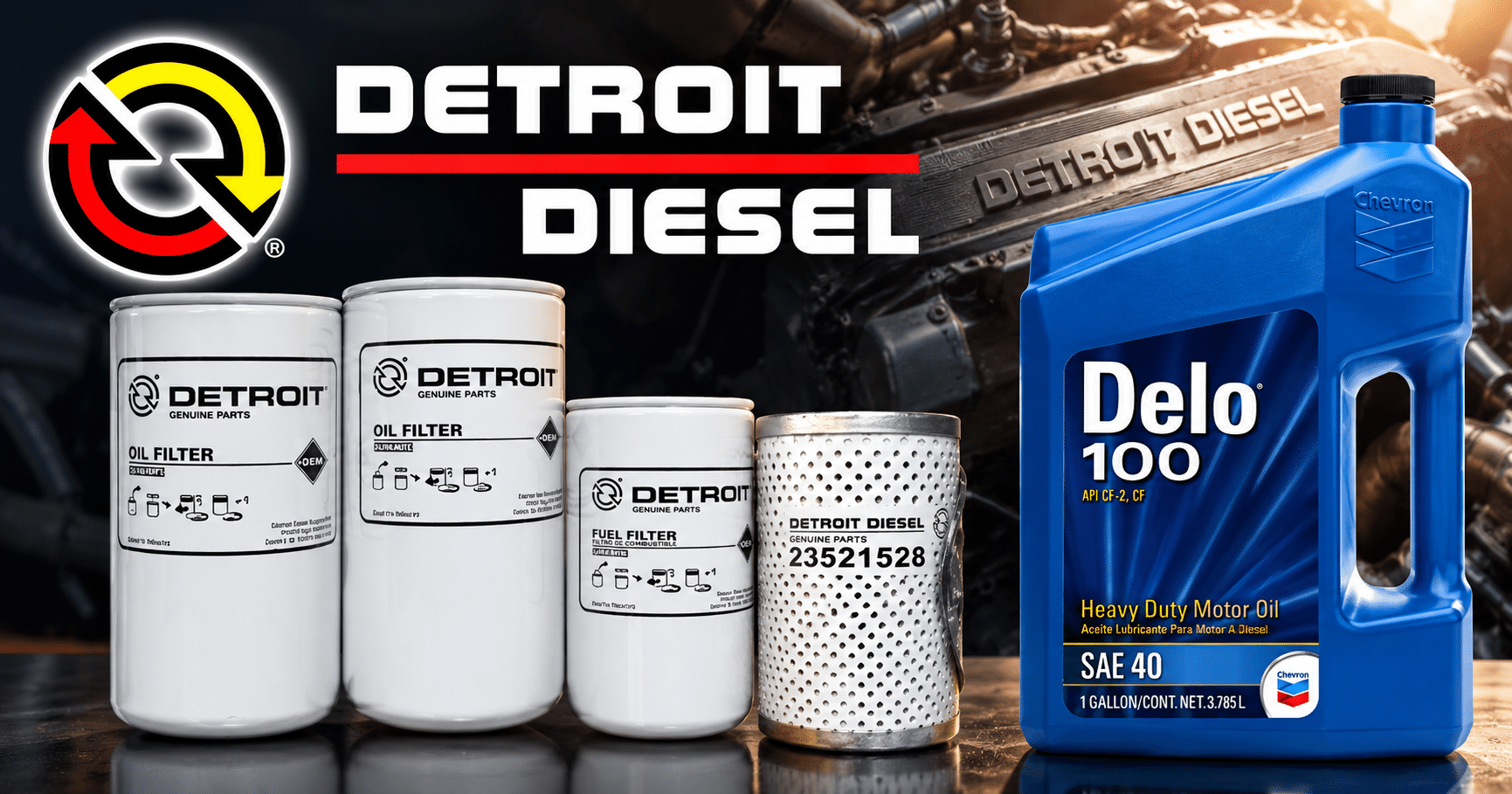
Knowing the correct oil type, engine-oil capacity and filter arrangement is especially important when servicing a Detroit Diesel marine engine. Classic Detroit two-stroke engines have lubrication requirements that are different from many modern four-stroke diesels. This Detroit Diesel marine engine oil type and capacity guide covers popular 53, 71, 92 and Series 60 engines, while our Marine Diesel Troubleshooting Guide can help diagnose low oil pressure, excessive oil consumption, blue smoke, overheating and other marine diesel problems.
Detroit Diesel Marine Engine Oil Type & Capacity Chart
Quick-reference oil capacities, lubrication requirements and oil-filter information for classic Detroit Diesel two-stroke marine engines and Series 60 marine diesels.
Detroit Diesel Marine Oil Capacity & Oil Type Chart
| Detroit Diesel Engine | Common Oil Capacity / Service Reference | Oil Filter | Recommended Oil |
|---|---|---|---|
| 4-53 / 4-53T | Installation dependent* | Verify by filter housing & serial number | SAE 40 monograde, API CF-2, low-ash two-stroke diesel oil |
| 6V53 / 6V53T | Installation dependent* | Verify by engine & filter configuration | SAE 40 monograde, API CF-2, sulfated ash below 1.0% |
| 6-71 / 6-71T / 6-71TI | Approx. 22–28 qt common configurations* | Spin-on or canister depending on configuration* | SAE 40 monograde, API CF-2, low-ash Detroit two-cycle oil |
| 6V71 / 6V71TI | Installation dependent* | Verify by engine & filter housing | SAE 40 monograde, API CF-2, sulfated ash below 1.0% |
| 8V71 / 8V71TI | Oil-pan / marine installation dependent* | Verify by serial number & filter arrangement | SAE 40 monograde, API CF-2, low-ash two-stroke diesel oil |
| 12V71 / 12V71TI | Approx. 10–12 gal / 40–48 qt common range* | Multiple full-flow filters depending on installation* | SAE 40 monograde, API CF-2, sulfated ash below 1.0% |
| 6V92 / 6V92TA | Approx. 7–8 gal common configurations* | Verify by serial number & filter housing | SAE 40 monograde, API CF-2, low-ash Detroit two-cycle oil |
| 8V92 / 8V92TA | Approx. 25–34 qt depending on configuration* | Verify by engine & filter configuration | SAE 40 monograde, API CF-2, sulfated ash below 1.0% |
| 12V92 / 12V92TA | Approx. 28–38 qt depending on configuration* | Verify by engine & filter configuration | SAE 40 monograde, API CF-2, low-ash Detroit two-cycle oil |
| Series 60 Marine | 38 qt pan FULL / approx. 43 qt total* | Detroit 23527033 / superseded applications must be verified | Detroit-approved heavy-duty four-stroke diesel oil; commonly SAE 15W-40 where specified |
IMPORTANT — VERIFY THE ENGINE MODEL, SERIAL NUMBER AND OIL PAN:
Detroit Diesel engines were manufactured in numerous marine, industrial and vehicle configurations. Oil-pan depth, engine angle, turbocharger arrangement, remote filtration, oil coolers and filter configuration can change the amount of oil required. Use the capacities above as service references and establish the final level with the correctly calibrated engine dipstick.
Capacity note: This is particularly important with older Detroit Diesel 53, 71 and 92 Series engines. Two engines carrying the same basic designation can have different sump and filter configurations. Do not assume that a capacity taken from another boat with the same engine family is automatically correct for your installation.
DETROIT TWO-STROKE OIL WARNING:
Classic Detroit Diesel Series 53, 71 and 92 engines should not automatically be treated like modern four-stroke diesels. Detroit specifications for these two-cycle engines call for a suitable SAE 40 monograde heavy-duty diesel oil with API CF-2 performance and sulfated ash below 1.0% under normal warm-weather operation. Always confirm the lubricant specification for the exact engine and operating conditions.
What Oil Should You Use in a Detroit Diesel Marine Engine?
The answer depends heavily on whether the engine is one of Detroit Diesel’s famous two-stroke engines or a later four-stroke design such as the Series 60.
For classic Detroit Diesel 53, 71 and 92 Series two-cycle engines, SAE 40 monograde oil has historically been the primary recommendation for normal operating temperatures. The lubricant should meet the appropriate Detroit two-cycle performance requirements, with API CF-2 being the important specification to look for in suitable currently available oils.
This is one of the most important differences between maintaining a classic Detroit and servicing many modern marine diesels. Choosing an oil simply because it says “heavy-duty diesel” on the container does not necessarily mean that it is the best lubricant for a Detroit two-stroke.
Why Detroit Diesel Two-Strokes Need the Correct Oil
Detroit’s classic two-cycle engines use a fundamentally different operating design from today’s four-stroke common-rail marine diesels. The 53, 71 and 92 Series use cylinder-wall intake ports, a Roots-type blower for scavenging and exhaust valves in the cylinder head.
The lubrication system therefore has to operate in an engine with different combustion, ring, liner and deposit-control characteristics than a typical modern four-stroke diesel.
Sulfated Ash Is Important
Detroit historically specified low-ash lubricant for its two-cycle engines. Excessive ash can contribute to combustion deposits and undesirable deposit formation around piston rings, exhaust components and cylinder areas.
For this reason, the oil’s actual specification matters more than simply buying whatever 15W-40 diesel oil happens to be available at the marina or automotive-parts store.
COMPACT TWO-STROKE
Detroit Diesel 4-53
The 4-53 is one of the smaller members of Detroit Diesel’s legendary two-cycle family. Its four cylinders displace 53 cubic inches each, giving the engine approximately 212 cubic inches of total displacement.
Marine installations can use different oil pans and filtration arrangements, so the correct fill quantity should be established from the engine configuration and dipstick rather than from displacement alone.
V6 TWO-STROKE
Detroit Diesel 6V53
The compact 6V53 was used in marine, industrial, military and commercial applications where a shorter V-engine package was advantageous.
Like other 53 Series engines, it should receive an appropriate Detroit two-cycle lubricant. SAE 40 CF-2 low-ash oil is the normal warm-weather reference rather than assuming that a modern automotive multigrade oil is automatically suitable.
LEGENDARY INLINE SIX
Detroit Diesel 6-71
The inline 6-71 is perhaps the most recognizable Detroit Diesel ever produced. Marine versions have powered commercial vessels, workboats, yachts and generators for decades.
Published references show roughly 22–28 quarts across common configurations, illustrating why the specific oil pan and installation must be identified before treating one number as universal.
CLASSIC V71
Detroit Diesel 6V71
The 6V71 packages six 71-cubic-inch cylinders into a compact V configuration. Naturally aspirated, turbocharged and intercooled versions were used in numerous marine installations.
Because sump and accessory configurations vary, fill the engine conservatively after service and establish the final level from the calibrated dipstick after the filters and oil galleries have been charged.
YACHT & COMMERCIAL FAVORITE
Detroit Diesel 8V71 / 8V71TI
The 8V71 and turbocharged 8V71TI became extremely common in motor yachts, sportfishing boats and commercial vessels. The engine displaces approximately 568 cubic inches and uses Detroit’s classic two-cycle architecture.
Oil capacities reported for this family vary substantially with oil-pan and marine configuration. For that reason, the engine serial number, model number and sump should be verified before ordering the final oil quantity.
LARGE V71 MARINE POWER
Detroit Diesel 12V71 / 12V71TI
The 12V71 was installed in larger yachts and commercial vessels where substantially greater power was required. Common references place many configurations in roughly the 10–12 gallon range.
The exact quantity can change with the sump, turbocharger configuration, filtration and marine installation. These engines may also use multiple full-flow filters, which must be included when calculating the complete service requirement.
COMPACT 92 SERIES
Detroit Diesel 6V92 / 6V92TA
The 6V92 increased displacement while retaining a relatively compact V6 package. Naturally aspirated, turbocharged and turbo-aftercooled configurations were produced for many applications.
Common references place several configurations around 7–8 gallons, but sump variations mean the engine’s identification and dipstick remain the final authority.
HIGH-OUTPUT TWO-STROKE
Detroit Diesel 8V92 / 8V92TA
The 8V92 became a familiar engine in larger motor yachts and sportfishing vessels. Its 736-cubic-inch displacement and turbocharged marine configurations provided considerably greater output than many earlier V71 installations.
Depending on configuration, published figures can range from the mid-20-quart area into the 30-quart range. This is precisely why an 8V92 should be filled according to its actual marine installation rather than a generic capacity alone.
HEAVY-DUTY V12
Detroit Diesel 12V92 / 12V92TA
The 12V92 is an 18.1-liter V12 two-stroke used in larger yachts and heavy commercial applications. Turbocharged marine versions can require approximately 38 quarts in certain configurations.
Other sump arrangements differ, so model and serial-number verification remains essential before performing a full oil service.
FOUR-STROKE ELECTRONIC DETROIT
Detroit Diesel Series 60 Marine
The Series 60 represents a major departure from the classic Detroit two-stroke architecture. It is an electronically controlled four-stroke inline-six and therefore has different lubrication requirements.
Detroit marine documentation lists approximately 38 quarts to the FULL mark without filters and approximately 43 quarts total after the filters and oil galleries are charged on the referenced marine configuration.
Detroit Diesel Marine Engine Oil Filters
Detroit Diesel filtration arrangements changed considerably across engine generations. Older 71 Series engines may use either canister-style or spin-on filtration, while later engines commonly use full-flow spin-on filters.
Filters the primary lubricating-oil flow before clean oil is distributed through critical engine components.
Large Detroit marine engines may use two or more filters, so the complete filter arrangement should be identified before beginning service.
The Series 60 provides a useful example of why filter numbers should be verified rather than copied blindly from an old parts list. Detroit documentation lists 23527033 as a full-flow filter in marine Series 60 information, while later replacement catalogs show superseding filter numbers for some applications.
FILTER PART-NUMBER NOTE:
Detroit Diesel engines have remained in service for many decades, and filter numbers have been superseded repeatedly. Filter bases may also have been converted or replaced during the engine’s service life. Confirm the engine serial number and physically verify the installed filter arrangement before ordering filters.
Need Detroit Diesel Marine Service?
805 Marine Diesel Mechanic provides Detroit Diesel oil and filter service, diagnostics, cooling-system maintenance, fuel-system troubleshooting and marine engine surveys throughout Ventura, Oxnard, Channel Islands Harbor and Santa Barbara.
How to Change the Oil Correctly on a Detroit Diesel
The published oil capacity should be treated as the starting reference—not an instruction to pour the entire quantity into the crankcase without checking the level.
1. Warm the Engine Before Draining
Whenever practical, bring the engine to normal operating temperature before draining or extracting the oil. Warm oil flows more readily and keeps more contaminants suspended so they can leave the engine with the old lubricant.
2. Replace All Lubricating-Oil Filters
Do not change the engine oil while leaving an old full-flow filter in service. On engines fitted with multiple filters, identify and replace the complete lubrication-filter arrangement according to the engine configuration.
3. Initially Fill Below the Expected Final Capacity
Add slightly less than the expected final quantity. This is particularly important on older 53, 71 and 92 Series marine engines because sump configurations vary.
4. Start the Engine and Verify Oil Pressure
Start the engine and confirm that oil pressure develops immediately. Inspect the oil filters, drain fittings, oil cooler connections and accessible lubrication lines for leakage.
5. Shut Down and Allow Drain-Back
After the filters and galleries have been charged, shut the engine down and allow sufficient time for oil to drain back into the sump.
6. Establish the Final Dipstick Level
Check the oil level with the vessel in its normal attitude and bring the level to the proper FULL mark. Do not deliberately overfill the crankcase in an attempt to compensate for anticipated oil consumption.
Detroit Diesel Oil Analysis & Engine Condition
Oil analysis can be particularly valuable on older Detroit Diesel marine engines because the results provide information that cannot be obtained simply by looking at the oil on the dipstick.
Laboratory analysis can identify wear metals, fuel dilution, coolant contamination, soot loading and abnormal changes in viscosity. Trending samples from the same engine over several services is considerably more valuable than relying on a single isolated sample.
Oil analysis is also useful during a Detroit Diesel Marine Engine Survey, where lubrication findings can be evaluated together with cold-start behavior, crankcase pressure, exhaust smoke, cooling-system condition, turbocharger condition and sea-trial performance.
Watch for Rising Oil Level
An unexplained increase in crankcase oil level should never be dismissed as harmless. Fuel dilution or coolant contamination can increase the apparent level while simultaneously reducing the lubricant’s ability to protect bearings, liners and other internal components.
Watch for Abnormal Oil Consumption
Detroit two-strokes have a reputation for using some oil, but a major change in consumption deserves investigation. Worn cylinder components, turbocharger leakage, excessive crankcase pressure and external leakage should be considered before simply adding oil indefinitely.
Detroit Diesel Preventive Maintenance
Correct engine oil is only one part of keeping a Detroit Diesel marine engine reliable. Cooling-system condition, raw-water pumps, heat exchangers, fuel filters, injectors, blower condition, turbochargers, exhaust components, air-box drains and crankcase ventilation all affect engine life.
Older Detroit engines are extremely durable when maintained correctly, but their age makes inspection especially important. Hoses, clamps, oil cooler cores, heat exchangers, exhaust components and seawater-system hardware may be decades newer—or older—than the engine itself.
Detroit Two-Stroke vs. Series 60 Oil Requirements
One of the biggest mistakes when discussing “Detroit Diesel oil” is treating every Detroit engine as though it uses the same lubricant.
Classic two-cycle Detroit Diesel engines. SAE 40 monograde CF-2 low-ash oil is the key normal-service reference.
Four-stroke electronically controlled diesel. Uses four-stroke heavy-duty diesel lubrication specifications rather than the classic Detroit two-cycle oil requirement.
That distinction matters. A lubricant appropriate for a Series 60 should not automatically be assumed to be the correct choice for an 8V71TI or 8V92TA merely because all three engines carry the Detroit Diesel name.
Detroit Diesel Factory & Technical References
Two-cycle lubricant requirement: Detroit technical information for Series 53, 71 and 92 engines specifies SAE 40 oil meeting the appropriate two-cycle performance requirement and emphasizes low sulfated-ash content.
Series 60: Detroit Series 60 documentation provides separate four-stroke lubrication requirements and warns that engine-oil capacity can vary according to the oil pan and application.
Because many Detroit Diesel marine engines are now several decades old, always use the complete engine model and serial number when confirming capacities, filters and service parts. Previous owners may also have changed filter bases, oil pans or auxiliary lubrication equipment during repowers and major overhauls.
Detroit Diesel Marine Mechanic
Oil & Filter Service • Diagnostics • Cooling Systems • Fuel Systems • Turbochargers • Detroit Two-Stroke Service • Marine Engine Surveys
Ventura • Oxnard • Channel Islands Harbor • Santa Barbara
Detroit Diesel Marine Engine Oil FAQ
Common questions about Detroit Diesel two-stroke oil, Series 53, 71 and 92 engines, Series 60 lubrication, oil capacities and marine-engine filters.
What oil should I use in a Detroit Diesel two-stroke marine engine?
Classic Detroit Diesel 53, 71 and 92 Series two-stroke engines normally call for a suitable SAE 40 monograde diesel oil meeting API CF-2 requirements for warm-weather operation. Low sulfated-ash content is important, and the exact lubricant requirement should always be verified for the engine and operating temperature.
Can I use 15W-40 in a Detroit Diesel 71 or 92 Series engine?
SAE 15W-40 should not automatically be substituted for the traditional SAE 40 monograde oil specified for classic Detroit Diesel two-cycle engines. The 53, 71 and 92 Series have different lubrication requirements from modern four-stroke diesels, so the oil specification matters more than simply selecting a common diesel viscosity.
Why does Detroit Diesel recommend low-ash oil?
Detroit Diesel two-strokes have combustion and cylinder-design characteristics that make deposit control particularly important. Excessive sulfated ash can contribute to deposits around piston rings, combustion areas and exhaust components, which is why low-ash oil has historically been specified.
What does API CF-2 mean for a Detroit Diesel?
API CF-2 is an oil-performance category developed specifically for severe-duty two-stroke diesel engines. For classic Detroit Diesel two-cycle engines, it remains an important specification when selecting an appropriate lubricant.
How much oil does a Detroit Diesel 6-71 hold?
Many 6-71 installations fall roughly in the 22-to-28-quart range, but there is no single capacity that applies to every marine 6-71. Oil-pan design, engine angle, filtration and installation details can change the required amount, so the final level must be established with the engine dipstick.
How much oil does a Detroit Diesel 8V71 hold?
The 8V71 was installed with multiple sump and filtration configurations, so its oil capacity is installation dependent. Rather than assuming one generic number applies to every 8V71 or 8V71TI, identify the oil-pan arrangement and use the calibrated dipstick to establish the final service level.
How much oil does a Detroit Diesel 12V71 hold?
Many marine 12V71 and 12V71TI installations fall approximately in the 10-to-12-gallon range. The exact amount varies with sump depth, filter configuration and installation, so the published figure should be treated as a service reference rather than a universal fill quantity.
How much oil does a Detroit Diesel 6V92 hold?
Several 6V92 marine configurations fall around the 7-to-8-gallon range, but different pans and engine arrangements can change the capacity. Always verify the complete engine model and establish the final level using the dipstick.
How much oil does a Detroit Diesel 8V92 hold?
Depending on sump and installation, common 8V92 marine-engine references can range from the mid-20-quart area into the 30-quart range. That variation is why a single generic capacity should not be used for every 8V92 or 8V92TA.
How much oil does a Detroit Diesel 12V92 hold?
Some 12V92 marine configurations use approximately 38 quarts, while other sump arrangements differ. Confirm the engine model, serial number and oil-pan configuration before assuming a specific service quantity.
How much oil does a Detroit Diesel Series 60 marine engine hold?
A referenced Series 60 marine configuration uses approximately 38 quarts to the FULL mark before the filters are charged and about 43 quarts total after the filters and lubrication galleries have filled. Oil-pan variations still mean the exact engine configuration should be confirmed.
Does a Detroit Diesel Series 60 use the same oil as an 8V71 or 8V92?
No. The Series 60 is a four-stroke diesel and should not automatically be serviced with the same oil specification used in classic Detroit two-strokes. The 53, 71 and 92 Series have their own two-cycle lubrication requirements.
Why do Detroit Diesel oil capacities vary so much?
Detroit engines were produced for marine, industrial, military, truck and generator applications using many different oil pans, filters and accessory arrangements. Even engines with the same basic model designation can therefore require different oil quantities.
Should I fill a Detroit Diesel with the entire published oil capacity at once?
No. Initially add slightly less than the expected capacity, start the engine, confirm oil pressure and allow the filters and galleries to fill. After shutdown and drain-back, bring the oil to the correct dipstick mark rather than blindly adding the entire published quantity.
Can overfilling a Detroit Diesel marine engine cause problems?
Yes. Excessive crankcase oil can contribute to aeration, increased oil consumption, oil carryover and crankcase-pressure problems. Overfilling is not a good way to compensate for normal oil consumption on an older Detroit.
Why does my Detroit Diesel use engine oil between services?
Some consumption can occur on older Detroit Diesel two-strokes, but a significant change deserves investigation. External leakage, worn liners or rings, turbocharger leakage, excessive crankcase pressure and other mechanical problems can all increase oil consumption.
What does it mean if the oil level on my Detroit Diesel is rising?
A rising crankcase level can indicate contamination rather than an engine that somehow created additional oil. Fuel dilution or coolant contamination should be investigated promptly because either condition can reduce lubrication quality and damage internal engine components.
How often should the oil and filters be changed on a Detroit Diesel marine engine?
The correct interval depends on the exact engine, hours of operation, duty cycle and service conditions. Follow the engine-specific maintenance schedule and consider more frequent servicing on lightly used marine engines where calendar time, moisture and contamination can become significant factors.
Is oil analysis useful on an older Detroit Diesel?
Yes. Oil analysis can identify wear metals, fuel dilution, coolant contamination, soot and changes in viscosity. It is especially useful when results are trended over multiple services and can also provide valuable information during a Detroit Diesel Marine Engine Survey.
Should I verify the Detroit Diesel serial number before ordering oil filters?
Yes. Detroit filter numbers have been superseded over time, and older engines may have had spin-on conversions, replacement filter bases or other modifications. Use the complete engine model and serial number and visually confirm the installed filtration system before ordering parts.
Detroit Diesel Marine Service
Oil & Filter Service • Two-Stroke Diagnostics • Cooling Systems • Fuel Systems • Turbochargers • Engine Surveys
Ventura • Oxnard • Channel Islands Harbor • Santa Barbara