
Marine diesel hose clamp selection and installation for safer fuel and cooling systems in Ventura, Oxnard, Channel Islands Harbor, and Santa Barbara.
Marine hose clamps are small components with big consequences. On a diesel-powered vessel, a failed clamp on a fuel line, exhaust hose, or raw water circuit can lead to leaks, overheating, or even flooding. At Santa Barbara Marine Diesel Mechanic, our trained technicians help owners choose the right clamp type, material, and installation technique for every hose on board, with a focus on reliability in Ventura, Oxnard, Channel Islands Harbor, and Santa Barbara Harbor.
Marine Hose Clamp Basics for Diesel Systems
Every marine diesel system—fuel, raw water, cooling, exhaust, hydraulic—relies on hose clamps to keep connections sealed under vibration, heat, and constant motion. The wrong clamp, poor material, or improper installation can create weak points in an otherwise well-built system.
In our local environment, clamps live in warm, salty, damp spaces: engine rooms, bilges, lazarettes, and tight chase runs. Perforated bands, thin materials, and crevice-prone designs can corrode quickly in Ventura and Santa Barbara Harbors. That’s why we focus on 316 stainless, solid-band, and constant-torque solutions that stand up to real-world conditions.
Common Marine Hose Clamp Types & Their Roles
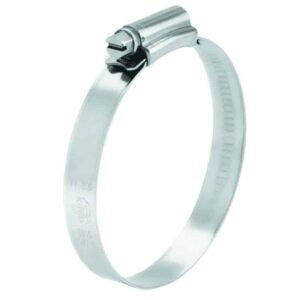
Perforated 316 Stainless-Steel Hose Clamps
Perforated 316 stainless-steel hose clamps are common and better than automotive-grade clamps, but they still have limitations. The screw threads are formed by perforations cut into the band, which removes a significant portion of the cross section. Under load, the band elongates, increasing the risk of micro-cracking and crevice corrosion—particularly in salt-heavy environments.
These clamps also use relatively thin bands, making it easier to strip the threads if over-tightened. Perforations can bite into the hose surface, especially on softer rubber, creating stress points and long-term damage. We still use them in select, low-risk applications, but they are rarely our first choice in critical diesel circuits.
Heavy-Duty Solid-Band 316 Stainless-Steel Clamps
Solid-band all-stainless-steel clamps are a major step up in quality and reliability. Instead of perforations, the threads are embossed into a thicker band. This design resists elongation, cracking, and stripping—even when clamps are torqued firmly.
Because the band is solid, there are no perforations to cut into hoses or to serve as starting points for crevice corrosion. Many premium clamps also feature slightly rolled edges that are gentler on the hose, reducing the risk of cold-flow damage over time.
Constant Torque, T-Bolt & Double T-Bolt Hose Clamps
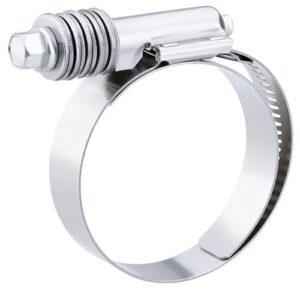
Constant Torque Hose Clamps
Constant torque clamps are often our preferred choice. Rubber hose “cold flows” after installation, compressing under the band and losing up to 80% of the initial torque. As systems heat up and cool down, metal fittings expand and contract. Standard worm gear and T-bolt clamps are passive—they cannot respond to these changes without manual adjustment.
Constant torque designs use a spring or Belleville washer assembly integrated into the worm gear. As hose and fittings move, the clamp actively adjusts its diameter to maintain consistent sealing force. This makes them ideal for raw water, coolant, and exhaust applications where temperature swings are significant.
Spring-Loaded Constant Torque T-Bolt Clamps
Spring-loaded constant torque T-bolt clamps combine robust T-bolt construction with an automatic diameter-adjusting mechanism. Key benefits include:
- Automatic compensation for thermal expansion and contraction
- Reliable clamping force without frequent manual re-torque
- Smooth inner bands that protect hoses from cuts and gouges
- Heavy-duty construction suitable for charge air cooling and high-pressure circuits
These are excellent choices for high-boost turbo plumbing, charge air coolers, and other demanding diesel applications.
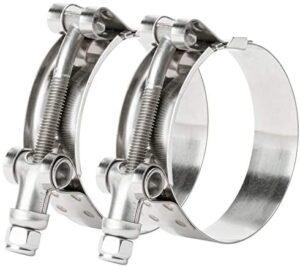
T-Bolt Clamps (Standard)
Standard T-bolt clamps are strong, but not without drawbacks. The T-bolt is retained by folding and spot-welding the band back onto itself, creating a pocket that can trap water. In damp bilge and stuffing box areas, this pocket becomes a prime site for crevice corrosion.
We also see uneven clamping around the circumference, with higher pressure in the region near the T-bolt and lower pressure elsewhere. For critical marine diesel applications, we often prefer constant torque or double T-bolt designs over basic T-bolts.
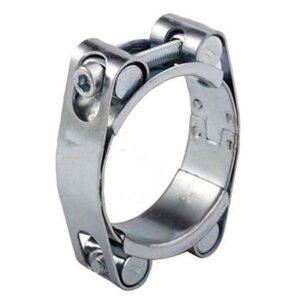
Double T-Bolt Stainless Steel Hose Clamps
Double T-bolt clamps are the “heavy artillery” of the clamp world. With a double band, robust bridge, and large trunnions, they distribute radial forces more evenly, achieving a seal faster and holding it under higher pressure. These are typically reserved for very high-pressure or high-stress applications where failure is not an option.
Why Hose Clamp Selection Matters on Marine Diesel Systems
A hose clamp is more than a hardware store item; on a diesel-powered vessel, it is a safety component. Poor clamp choices and installations can lead to:
- Fuel leaks in the engine room
- Raw water leaks that overwhelm bilge pumps
- Coolant loss and overheating under load
- Exhaust leaks, soot, and dangerous fumes
- Unexpected downtime and expensive emergency repairs
Using high-quality 316 stainless, solid bands, constant torque designs, and proper sizing greatly reduces these risks. Our trained technicians evaluate each connection—fuel, cooling, exhaust—and match the clamp to the load, temperature range, and environment.
Core Marine Hose & Clamp Services We Provide
At Santa Barbara Marine Diesel Mechanic, we don’t just “replace clamps.” We audit and upgrade entire hose and clamp systems around your diesel engines.
- Engine room hose and clamp inspections (fuel, raw water, coolant, exhaust)
- Replacement of automotive-grade clamps with 316 stainless marine-grade hardware
- Installation of heavy-duty solid-band and constant torque clamps where appropriate
- Correction of double-clamping patterns at seacocks, thru-hulls, and exhaust outlets
- Documentation of all critical connections and recommendations by risk level
These services integrate naturally with broader work scopes like Cummins marine technology upgrades, fuel filtration improvements, and cooling system flushing.
Advanced Hose Clamp Practices & Owner Tips
- Use a magnet: When shopping for clamps, use a magnet on the band, screw, and housing. If it sticks strongly, the metal may not be true 316 stainless.
- Match clamp to hose OD: Oversized clamps that are nearly “bottomed out” on the band are more likely to distort and provide uneven pressure.
- Avoid mixing metals: Minimize dissimilar metals at clamp locations to reduce galvanic and crevice corrosion.
- Use rolled-edge bands: Rolled edges are gentler on hoses and reduce cutting, especially on soft raw-water and coolant hose.
- Document torque and intervals: For high-value systems, we can record recommended re-check points tied to engine hours or seasons.
Long-Term Benefits of Proper Marine Hose Clamp Strategy
- Fewer leaks and emergency repairs
- More predictable raw water and cooling performance
- Reduced risk of fuel leaks and engine room hazards
- Longer hose life thanks to gentler, more even clamping
- Higher confidence on long runs to the Channel Islands and beyond
Small hardware choices add up. Investing once in the right clamps and installation techniques can pay off for years in reliability and peace of mind.
Upgrading Legacy Clamp Installations on Older Boats
Many older boats still rely on mismatched hardware-store clamps, mixed metals, and non-marine materials. During repowers or major service on Yanmar, Caterpillar, Cummins, or Perkins engines, we take the opportunity to upgrade hose and clamp systems to modern standards.
We also factor in future upgrades—bigger coolers, new exhaust components, or fuel system changes—so clamp choices today can accommodate tomorrow’s system loads and layouts without needing a full re-do.
Trained Technicians & Our Hose & Clamp Workflow
Our hose clamp work follows the same disciplined approach we apply to marine diesel engines:
- Initial engine room survey and photo documentation
- Risk-based categorization of connections (critical, important, low-risk)
- Clamp type recommendations based on location, duty, and temperature
- Installation using proper spacing, band alignment, and torque practices
- Final inspection and owner walkthrough of critical locations
Our trained technicians explain what we did, why we did it, and how to visually monitor clamps going forward.
Marine Hose Clamp Services in Ventura, Oxnard & Santa Barbara
We offer mobile hose and clamp inspection and upgrade services across:
- Ventura Harbor
- Oxnard & Channel Islands Harbor
- Santa Barbara Harbor
Whether you run a single Yanmar, twin Cummins QSM11s, or a mixed diesel fleet, we can audit and upgrade your clamps alongside regular maintenance. For reference on related diesel topics, many owners also review resources like BoatUS, Yachting Magazine, and manufacturer sites such as Cummins Marine and Volvo Penta Marine.
Schedule a Marine Hose & Clamp Inspection
If it’s been years since anyone reviewed your hose clamps—or if you’ve upgraded engines or systems—it’s the perfect time for a professional inspection. Our trained technicians at 805 Marine Diesel Mechanic can identify weak links, recommend better hardware, and upgrade your clamps so they match the quality of your diesel power.
Marine Hose Clamp FAQ
Why are perforated hose clamps not ideal for critical marine diesel applications?
Perforated bands remove metal from the clamp, making them prone to elongation, micro-cracking, and crevice corrosion in salty environments. They can also bite into hoses and are easier to strip when over-tightened.
What’s the advantage of solid-band 316 stainless-steel clamps?
Solid-band clamps use embossed threads and thicker bands, which resist elongation and stripping, are gentler on hoses, and eliminate perforations that can start corrosion and hose damage.
When should I use constant torque hose clamps?
Constant torque clamps are ideal anywhere temperatures and loads vary—raw water, coolant, and exhaust connections—because they automatically adjust as hoses and fittings expand and contract, maintaining a more consistent seal.
Are T-bolt clamps good for marine use?
Standard T-bolt clamps are strong but can trap water in the folded band area and may apply uneven clamping pressure. In many marine diesel applications we prefer constant torque or double T-bolt designs, especially in routinely wet locations.
Do you offer mobile hose clamp upgrades in my harbor?
Yes. We provide mobile hose and clamp inspections and upgrades in Ventura, Oxnard, Channel Islands Harbor, and Santa Barbara Harbor, often combined with engine maintenance or fuel system work.
How can I quickly check clamp material quality?
A simple magnet test helps: strong attraction can indicate lower-grade stainless or mixed metals. We also look at band thickness, construction, and manufacturer markings to ensure clamps are appropriate for marine diesel service.