
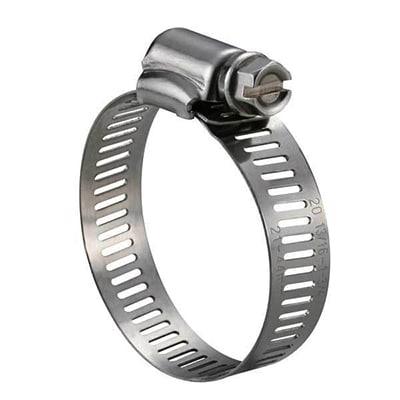
Marine Engine Hose Clamp Upgrade; #1 — Perforated 316 Stainless
First up is the familiar perforated 316 stainless-steel hose clamp. It’s widely used and affordable—but it has trade-offs.
These clamps rely on a series of perforations cut into the band to form screw threads. Those perforations remove cross-sectional material, weakening the band and allowing it to elongate under tension.
Elongation can lead to micro-cracking—an entry point for crevasse corrosion common to stainless alloys. When hose clamps fail, it’s often along those perforations from overstress, corrosion, or both.
Another drawback: the band is typically thin, so it’s easier to strip threads if you over-tighten the screw.
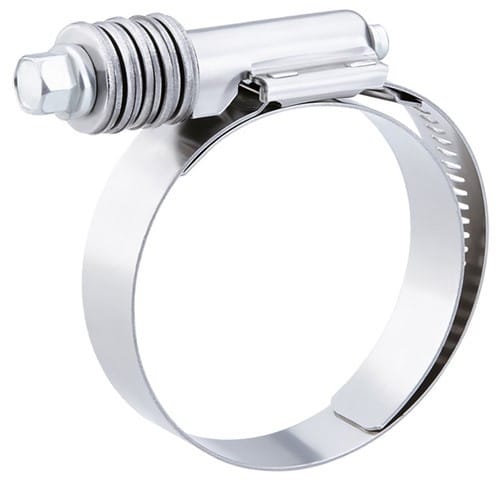
Constant Torque Hose Clamps: #2
Our favorite for most marine applications. Virtually all rubber hose “cold-flows” after installation, creating an immediate torque loss that can exceed 80% of the original clamp torque.
Meanwhile, metals expand when hot and contract when cool. Conventional worm-gear, T-bolt, and similar clamps are passive—they can’t adapt to those changes without manual re-tightening.
A constant torque hose clamp is an “active” mechanism that automatically compensates for movement by changing diameter through a worm-gear + Belleville spring assembly. The result is a more consistent seal through expansion and contraction cycles.
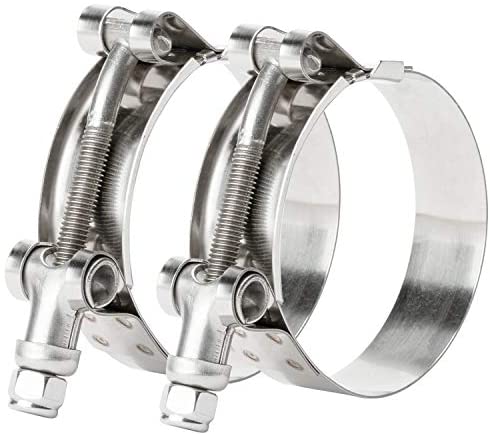
T-Bolt Stainless Steel Hose Clamp: #3
These can exert significant force, but that force can concentrate near the bolt rather than distributing evenly around the circumference. Where more constant, even pressure is desired, spring-loaded designs keep tension steadier—see the constant-pressure options and constant pressure approaches. Marine Engine Hose Clamp Upgrade.
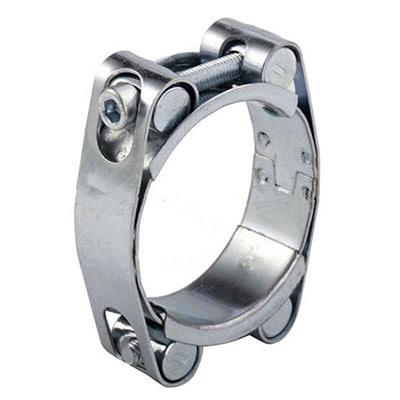
Double Bolt Hose Clamp: #4
The “king of clamps” is also the most expensive. With bolts at both ends, you can tighten evenly from both sides for a stronger, uniform seal. Robust rollers back up the band strength. If maximum durability is the goal, this design delivers.
Upgrade Your Yacht with Constant Torque Hose Clamps from 805 Marine Mechanic
For consistent sealing under heat, vibration, and load, constant torque clamps are our go-to. They reduce re-tightening, mitigate leak risk, and stand up to Central Coast conditions.
805 Marine Mechanic is your friendly, on-site partner for clamp upgrades and full diesel service—dockside in the Channel Islands, Ventura, and Santa Barbara.
Upgrade Your Yacht Now
Why Constant Torque Hose Clamps?
They maintain a seal as hoses expand/contract, lowering leak potential and protecting engines and crews. Ours are built from corrosion-resistant materials for long service life in salt and spray.
Result: fewer “wrench checks,” better uptime, and peace of mind on every run.
Benefits of Professional Marine Services
With 805 Marine Mechanic you get proper sizing, correct torque, smart hose routing, and inspection of mating surfaces—little details that prevent big problems.
We bring the parts, tools, and expertise to your slip—saving you time and avoiding avoidable do-over work.
Why Marine Hose Clamp Upgrades Matter for Long-Term Reliability
Hose clamps keep coolant, fuel, raw water, and exhaust gases where they belong. A single failure offshore can mean overheating, flooding, or shutdowns. Harsh marine conditions—salt, humidity, vibration, temperature swings—demand clamps that hold steady.
Perforated bands are affordable but more vulnerable to stress and corrosion. Constant torque, T-bolt, and double-bolt designs offer more stable force and service life for critical runs.
Choosing the Right Hose Clamp for Your Marine Engine
- Perforated Stainless Clamps — Common and budget-friendly; best for light-duty or temporary use. Watch for thread strip and perforation corrosion.
- Constant Torque Clamps — The marine sweet spot: springs maintain tension as systems cycle. Excellent on fuel, coolant, and exhaust water hoses.
- T-Bolt Clamps — High clamping force for large-diameter or boosted/high-pressure connections; ensure even pressure and check after heat cycles.
- Double-Bolt Clamps — Maximum durability and even pressure for heavy-duty installations; premium price, premium security.
Selecting the right clamp is about fit + function + environment. A pro marine mechanic will match the clamp to hose material, barb/bead, temperature, pressure, and service access.
The Role of Professional Marine Services
- Expert installation: Correct torque, placement, and retorque schedule after first heat cycles.
- Preventive inspections: Spot hose creep, clamp fatigue, and corrosion early.
- Modern diagnostics: Temperature and pressure checks to confirm sealing under load.
- Longevity: Best-practice upgrades improve safety and resale value.
Tip: After any new clamp install, re-check torque after initial run-in. Rubber cold-flow can drop clamp load rapidly.
SEO Tip: When to Replace Marine Hose Clamps
- Visible rust or staining
- Cracks along perforations
- Stripped threads or sudden loss of tension
- Dampness or drips at joints
- Hoses stiff/brittle or indented under the band
Plan routine replacement every few seasons—or sooner for high-heat/high-salinity duty. Pair replacements with hose inspections.
Why 805 Marine Mechanic
- Inboard diesel specialists—we live and breathe marine diesel systems.
- Mobile convenience—dockside service in Channel Islands, Ventura & Santa Barbara.
- Quality parts—marine-grade stainless clamps and OEM-spec components.
- Clear communication—practical guidance, photos, and maintenance plans.
Service area: Channel Islands • Ventura • Santa Barbara