
Common MAN Marine Engine Survey Findings
MAN marine diesel engines are known for strong acceleration, high power density, compact installation footprints, and excellent performance in luxury yachts, sportfishing vessels, and commercial marine applications. While MAN engines have a strong reputation throughout the marine industry, surveys frequently uncover maintenance-related concerns, cooling-system deficiencies, fuel-system contamination, electronic diagnostic faults, turbocharger issues, and deferred service items that can significantly affect ownership costs. Understanding the most common MAN marine engine survey findings helps buyers evaluate vessel condition before purchase.
MAN Survey Navigation
Electronic Diagnostic Faults
One of the most common MAN survey findings involves stored or active electronic fault codes. Modern MAN engines depend heavily on electronic controls, sensors, engine management systems, and vessel monitoring systems. Diagnostic review frequently reveals sensor failures, communication faults, operating-limit exceedances, alarm history, and maintenance reminders that may not be visible during a basic visual inspection.
- Stored fault codes
- Active alarms
- Sensor failures
- Communication faults
- Historical alarm events
- Engine protection events
Cooling-System Deficiencies
Cooling-system problems are among the most common survey findings on high-output MAN marine engines. Heat exchangers, charge-air coolers, aftercoolers, raw-water pumps, thermostats, and coolant systems require regular maintenance to maintain performance and reliability.
- Restricted heat exchangers
- Charge-air cooler contamination
- Aftercooler service needs
- Coolant contamination
- Raw-water pump wear
- Cooling-system leaks
MAN Marine Engine Cooling System Maintenance
Aftercooler Service Issues
One of the most significant findings on MAN engines involves neglected aftercooler maintenance. Aftercooler contamination can reduce airflow efficiency, increase operating temperatures, decrease performance, and contribute to expensive long-term engine damage.
- Corrosion inside aftercoolers
- Restricted airflow
- Reduced boost efficiency
- Elevated operating temperatures
- Performance loss
MAN Aftercooler Failure Authority Guide
Fuel Contamination and Filtration Problems
Fuel contamination remains one of the most common survey findings regardless of engine manufacturer. MAN engines rely on clean fuel and proper filtration to protect injectors, pumps, and high-pressure fuel-system components.
- Water contamination
- Fuel-tank sludge
- Restricted filters
- Microbial growth
- Fuel-delivery concerns
MAN Marine Engine Fuel System Upgrade
Turbocharger and Charge-Air Issues
Turbocharger performance is critical on MAN marine engines. Survey findings frequently include boost leaks, turbocharger wear, restricted intake systems, and charge-air cooler service needs.
- Turbocharger wear
- Boost leaks
- Charge-air cooler contamination
- Restricted intake systems
- Reduced airflow
Oil Analysis Abnormalities
Oil analysis frequently reveals hidden concerns that are not visible during inspection. Wear metals, coolant contamination, fuel dilution, soot loading, and lubricant-condition concerns often help identify developing issues before they become major failures.
- Elevated wear metals
- Fuel dilution
- Coolant contamination
- Soot loading
- Lubricant degradation
Exhaust-System Concerns
Exhaust systems experience significant thermal cycling and vibration. Surveys commonly uncover corrosion, support failures, exhaust leaks, and deterioration of exhaust-system components.
- Exhaust leaks
- Corrosion
- Support failures
- Thermal-stress damage
- Exhaust restrictions
Low Power and Failure To Reach Rated RPM
Sea-trial evaluations sometimes reveal engines that cannot achieve rated RPM. Causes may include fuel restrictions, turbocharger deficiencies, cooling-system concerns, hull fouling, propeller overload, or engine-performance limitations.
- Fuel restrictions
- Turbocharger deficiencies
- Cooling-system concerns
- Propeller overload
- Hull fouling
- Electronic derates
Deferred Maintenance
The most common overall MAN survey finding is deferred maintenance. Many vessels have incomplete service records or overdue maintenance involving cooling systems, aftercoolers, fuel systems, turbochargers, injectors, and electronic monitoring systems.
MAN Yacht Applications
Many MAN-powered yachts deliver exceptional performance when properly maintained. Survey findings often help buyers understand maintenance history and future service exposure before purchasing high-performance vessels.
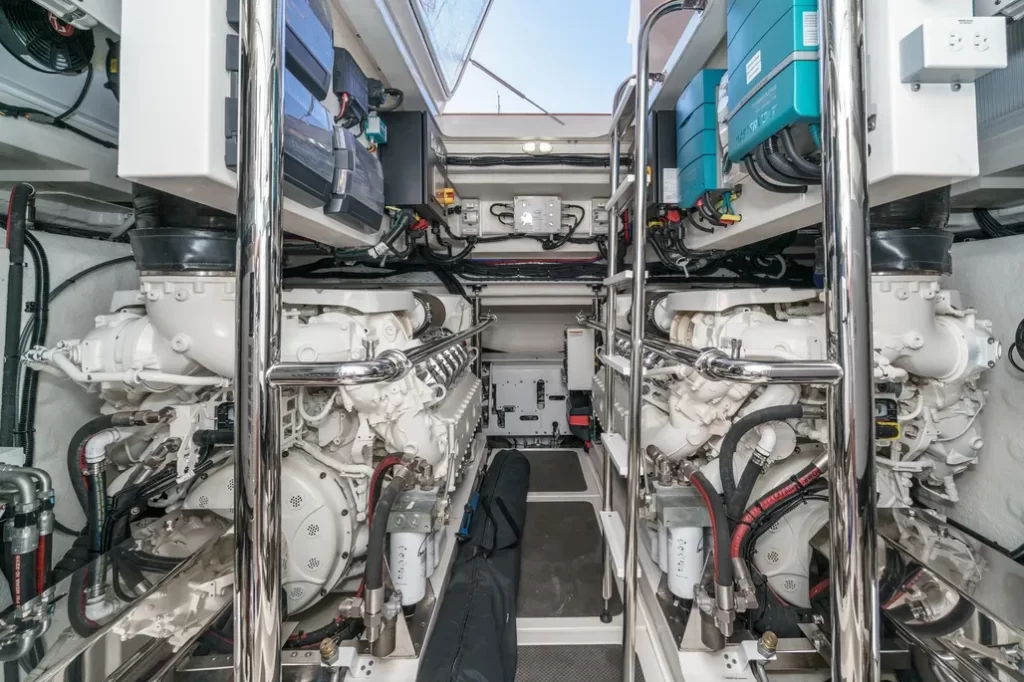
Pershing Yacht 7X Powered by Twin MAN V12 1800 Diesel Engines
Common MAN Survey Findings Summary
- Electronic diagnostic faults
- Cooling-system deficiencies
- Aftercooler contamination
- Fuel contamination
- Turbocharger concerns
- Oil-analysis abnormalities
- Exhaust-system issues
- Low-power complaints
- Failure to reach rated RPM
- Deferred maintenance
External Resources
Service Areas
805 Marine Diesel Mechanic performs MAN marine engine surveys throughout Ventura Harbor, Channel Islands Harbor, Oxnard, Santa Barbara Harbor, Marina del Rey, Malibu, and Port Hueneme.
Common MAN Marine Engine Survey Findings FAQ
What are the most common MAN marine engine survey findings?
Common findings include cooling-system deficiencies, aftercooler contamination, fuel contamination, electronic fault codes, turbocharger concerns, oil-analysis abnormalities, low-power complaints, and deferred maintenance.
Why are electronic diagnostic faults commonly discovered during surveys?
Modern MAN engines rely heavily on electronic engine management systems. Diagnostic reviews frequently uncover stored faults, active alarms, sensor failures, communication issues, and historical operating events.
Can stored fault codes indicate serious problems?
Yes. Fault history can reveal recurring issues, engine-protection events, sensor failures, communication concerns, and maintenance deficiencies that may affect reliability and repair costs.
Why are cooling-system problems common survey findings?
High-output MAN engines depend on properly maintained heat exchangers, charge-air coolers, aftercoolers, coolant systems, and raw-water pumps. Deferred maintenance can significantly impact engine reliability.
What cooling-system issues are commonly found?
Restricted heat exchangers, aftercooler contamination, coolant degradation, raw-water pump wear, thermostat problems, cooling-system leaks, and charge-air cooler service needs are commonly discovered.
Why are aftercoolers important on MAN marine engines?
Aftercoolers reduce intake-air temperatures and improve combustion efficiency. Poor aftercooler condition can reduce performance, increase operating temperatures, and contribute to engine damage.
What fuel-system issues are commonly identified?
Water contamination, fuel-tank sludge, microbial growth, restricted filters, injector concerns, and fuel-delivery deficiencies are among the most common findings.
Why are turbochargers inspected during a survey?
Turbochargers directly affect horsepower, fuel efficiency, acceleration, smoke output, exhaust temperatures, and overall engine performance.
What turbocharger-related issues are commonly found?
Turbocharger wear, boost leaks, airflow restrictions, charge-air cooler contamination, and reduced boost performance are common survey findings.
Why is oil analysis important during a survey?
Oil analysis helps identify wear metals, coolant contamination, fuel dilution, soot loading, and lubricant-condition concerns that may not be visible during a visual inspection.
Can oil analysis reveal hidden engine problems?
Yes. Oil analysis frequently identifies abnormal wear patterns and contamination concerns long before performance symptoms appear.
What exhaust-system problems are commonly discovered?
Exhaust leaks, corrosion, support failures, thermal-stress damage, and exhaust restrictions are commonly identified during surveys.
Why do some MAN engines fail to reach rated RPM?
Fuel restrictions, turbocharger deficiencies, cooling-system concerns, propeller overload, hull fouling, electronic derates, and engine-performance issues can prevent rated RPM from being achieved.
What is an electronic derate?
An electronic derate occurs when the engine management system limits performance to protect the engine from operating conditions that could cause damage.
Is deferred maintenance common on MAN-powered vessels?
Yes. Deferred maintenance involving cooling systems, aftercoolers, turbochargers, fuel systems, injectors, and electronic controls is one of the most common survey findings.
Can a survey identify overheating risks?
Yes. Cooling-system inspections, diagnostics, oil analysis, pressure testing, and sea-trial observations frequently identify overheating risks before purchase.
Are MAN marine engines reliable?
Yes. MAN engines are highly respected throughout the marine industry for performance, acceleration, fuel efficiency, and long-term durability when properly maintained.
Do you perform MAN surveys in Marina del Rey?
Yes. Marina del Rey is one of our active MAN marine engine survey service areas.
Do you perform MAN surveys in Ventura Harbor and Channel Islands Harbor?
Yes. Ventura Harbor, Channel Islands Harbor, Oxnard, Santa Barbara Harbor, Marina del Rey, Malibu, and Port Hueneme are included when scheduling allows.
How do I schedule a MAN marine engine survey?
Call 805-774-0637 or use the contact page to discuss vessel location, engine model, diagnostic access, survey timing, and sea-trial availability.